
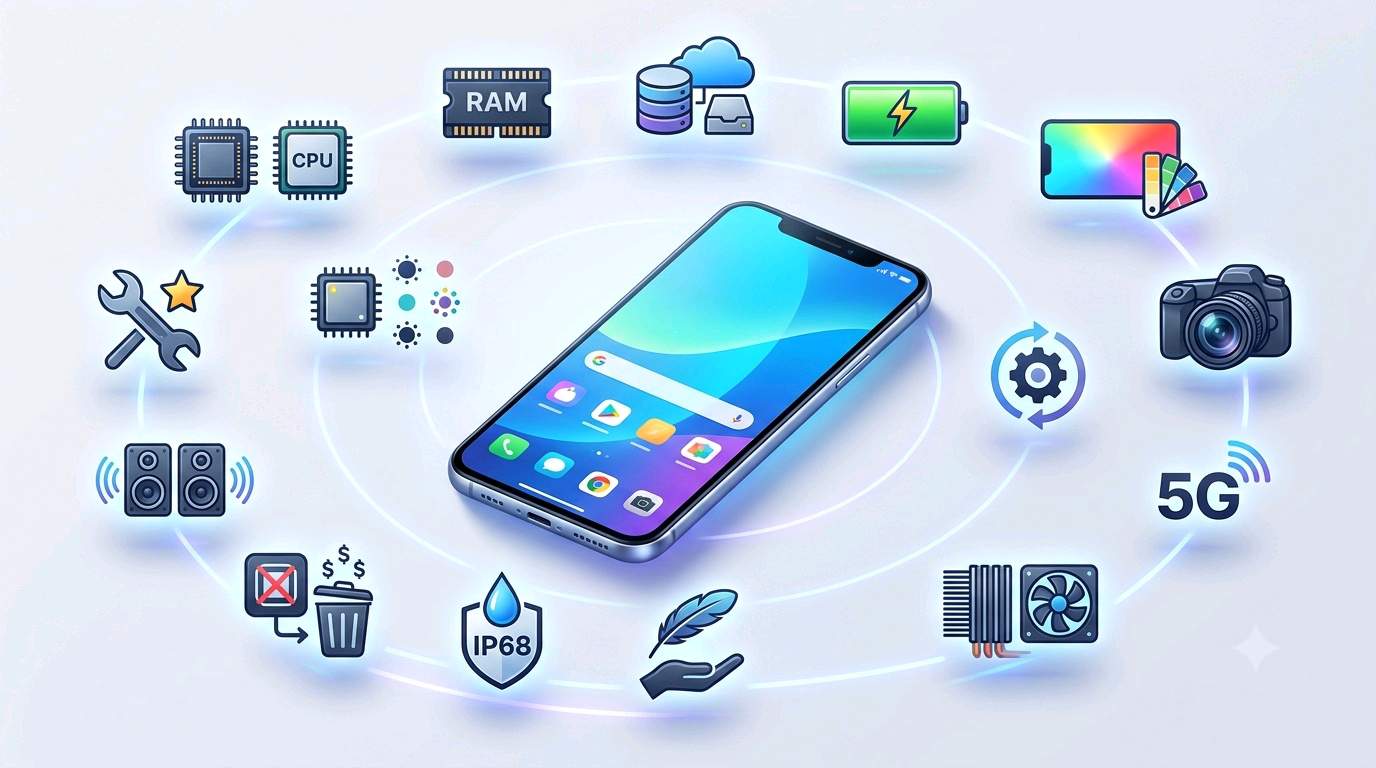
Buying a smartphone is not only about choosing the newest model or the highest megapixel camera. A good phone should match the way you actually use it. Before buying, check the processor, RAM and storage, battery, charging speed, display, camera, software updates, 5G bands, cooling, weight, IP rating, bloatware, speakers, service availability and sensors. Ignoring these features can lead to problems such as lag, storage warnings, fast battery drain, overheating, poor photos, weak network compatibility and expensive repairs.
15 Things to Check Before Buying a Smartphone
This smartphone buying guide explains the most important specifications in simple language. It also tells you what kind of problem you may face when an important feature is missing or inadequate.
1. Processor: Check Performance Before Buying
The processor or chipset is one of the most important components of a smartphone. It controls much of the phone's performance, including app loading, multitasking, gaming, image processing and video editing.
Do not judge a processor only by its name or clock speed. Look at the chipset generation, CPU and GPU capabilities, efficiency and real-world reviews.
What happens if the processor is weak?
2. RAM and Storage: Think About Long-Term Use
RAM helps a phone keep apps active for multitasking, while storage is used for applications, photographs, videos, documents and system files.
More RAM does not automatically make every phone better, but insufficient RAM can make multitasking uncomfortable. Storage is equally important, especially if you record videos, install games or keep large media libraries.
What happens with insufficient RAM or storage?
3. Battery Capacity: Look Beyond the mAh Number
Battery capacity is usually expressed in mAh. A larger capacity can help provide longer runtime, but battery life also depends on the display, processor efficiency, software, network strength, camera usage and gaming.
Before buying, check independent battery tests when available instead of relying only on the advertised capacity.
What happens with poor battery life?
4. Charging Speed: Save Time Every Day
Fast charging can be extremely useful for people who use their phones heavily. However, charging speed should be considered alongside charger compatibility, battery health features and thermal management.
Also check whether the required charger is included or sold separately.
What happens with slow charging?
5. Display: Check Brightness, Refresh Rate and Quality
The display affects almost everything you do on a smartphone. Check screen technology, resolution, brightness, refresh rate, viewing angles, colour quality and touch response.
A higher refresh rate can make scrolling and animations feel smoother, while high brightness is important for outdoor visibility.
What happens with a poor display?
6. Camera: Megapixels Are Not Everything
When choosing a camera phone, don't look only at megapixels. Sensor size, lens quality, optical image stabilization, autofocus, image processing and low-light performance can have a major impact on results.
For video creators, also check stabilization, microphone quality, frame-rate options and video resolution.
What happens if you choose only by megapixels?
7. Software Updates: An Important Long-Term Feature
Software support is one of the most overlooked factors when people compare smartphones. Check how long the manufacturer promises operating system updates and security updates.
Regular security updates can help protect the device against known vulnerabilities, while major software updates can add features and improve compatibility.
What happens without good software support?
8. 5G Bands and Network Compatibility
A phone may be advertised as 5G, but that does not mean it supports every 5G frequency used around the world. Network bands vary between regions and operators.
If you travel internationally or change carriers frequently, checking supported bands is especially important.
What happens with limited 5G bands?
9. Heating and Cooling System
Gaming, video recording, video editing, navigation and high-speed connectivity can generate heat. A good smartphone should have effective thermal management.
Look for information about cooling systems, sustained performance and thermal throttling in reliable reviews.
What happens with excessive heating?
10. Weight and Ergonomics
A smartphone may have excellent specifications but still be uncomfortable to use. Consider weight, thickness, dimensions, grip and one-handed usability.
Large batteries and camera systems can make modern phones heavier. The ideal weight depends on personal preference and how long you normally use the phone.
What happens with an excessively heavy phone?
11. IP Rating: Protection Against Water and Dust
An IP rating indicates a device's level of protection against dust and water under specified testing conditions. It is useful for people who frequently use their phones outdoors.
However, water resistance is not the same as being completely waterproof, and protection can change after drops, repairs or normal wear.
What happens without suitable protection?
12. Bloatware and Unwanted Ads
Some smartphones come with many pre-installed applications. These are commonly called bloatware when they are unnecessary to the user.
Before buying, check reviews to see whether the phone's software contains excessive pre-installed apps, promotional notifications or unwanted advertising.
What happens with excessive bloatware?
13. Speakers: Check Audio Quality
If you watch videos, play games or make speakerphone calls frequently, audio quality matters. Look for stereo speakers, loudness, clarity and distortion control.
What happens with a weak speaker system?
14. Service Centre and Spare Parts Availability
After-sales support is just as important as specifications. Before purchasing, check whether the manufacturer has authorized service centres, spare parts availability and reliable warranty support in your region.
What happens without convenient service?
15. Sensors: Small Components, Big Importance
Smartphones use several sensors, including the proximity sensor, accelerometer, gyroscope, ambient light sensor, compass and fingerprint-related hardware, depending on the model.
These components support everyday functions such as automatic screen behaviour during calls, screen rotation, navigation, brightness adjustment and motion-based features.
What happens with poor sensors?
15 Smartphone Buying Factors at a Glance
| Factor | What to Check | Possible Problem if Poor |
|---|---|---|
| Processor | Performance, efficiency, GPU | Lag and slow performance |
| RAM & Storage | Memory and available storage | Storage full, app reloads |
| Battery | Capacity and real-world endurance | Frequent charging |
| Charging | Charging speed and compatibility | Long charging time |
| Display | Brightness, refresh rate, panel | Poor outdoor visibility |
| Camera | Sensor, OIS, autofocus, processing | Poor low-light photos |
| Updates | OS and security support | Security and compatibility concerns |
| 5G Bands | Carrier/network compatibility | Limited 5G connectivity |
| Cooling | Thermal management | Overheating and throttling |
| Weight | Ergonomics and comfort | Hand fatigue |
| IP Rating | Dust/water protection | Higher liquid exposure risk |
| Bloatware | Pre-installed apps and ads | Annoying notifications |
| Speakers | Stereo setup and audio quality | Weak or thin sound |
| Service | Warranty and repair network | Repair difficulties |
| Sensors | Proximity, gyro, compass, etc. | Incorrect touch or functions |
How to Choose a Smartphone for Your Needs
There is no single smartphone that is perfect for everyone. The right choice depends on your primary use.
For Gaming
Prioritize a capable processor, GPU performance, cooling system, high-refresh-rate display, battery capacity and responsive touch sampling. Storage is also important because modern games can occupy a large amount of space.
For Photography
Look beyond megapixels. Check the main sensor, OIS, autofocus, image processing, low-light performance and camera consistency.
For Video Editing
A powerful chipset, sufficient RAM, fast storage, a good display and strong battery life are important. If you edit high-resolution footage, storage capacity becomes especially valuable.
For Watching Videos
Choose a phone with a good-quality display, strong brightness, good viewing angles and capable speakers. A large battery can make long streaming sessions more convenient.
For Calls and Basic Use
You may not need the most powerful processor. Instead, focus on call quality, network compatibility, battery life, software reliability, speaker quality and comfortable design.
For Social Media
A balanced smartphone is usually better than an extreme specification sheet. Look for a good display, reliable camera, smooth performance, adequate storage, strong battery life and dependable software.
Common Smartphone Buying Mistakes to Avoid
- Choosing only by megapixels: Camera quality depends on much more than resolution.
- Buying only because of RAM: Software optimization and processor performance also matter.
- Ignoring software support: Long-term updates are important for security and usability.
- Ignoring network bands: 5G compatibility can differ between markets and carriers.
- Focusing only on battery capacity: Real battery life depends on many hardware and software factors.
- Ignoring weight: A large, heavy phone may become uncomfortable.
- Not checking service availability: Repairs can become difficult without proper local support.
- Buying without considering storage: Photos, videos, games and apps can quickly consume space.
Smart buying tip: Make a short checklist based on your actual usage. If gaming is your priority, give more importance to performance and cooling. If photography is your priority, investigate camera quality. If you keep a phone for many years, software support, battery health and service availability become especially important.
Frequently Asked Questions About Buying a Smartphone
What is the most important thing to check before buying a smartphone?
There is no single specification that matters most for everyone. Generally, check the processor, RAM, storage, battery, display, camera, software support and network compatibility according to your usage.
Is a higher megapixel camera always better?
No. Sensor quality, lens, OIS, autofocus and image processing can have a major effect on real-world photo quality.
How much RAM should a smartphone have?
The ideal amount depends on the operating system, software optimization and usage. Instead of focusing only on RAM, consider the complete performance package and how much multitasking you actually do.
Why are 5G bands important?
Different mobile networks use different frequency bands. A phone with limited supported bands may not connect to every compatible 5G network in every location.
Is fast charging important when buying a phone?
Fast charging can be very useful for heavy users, but also consider charger availability, thermal management and battery health features.
Why should I check software updates?
Regular updates can provide new features, bug fixes and security patches. Long software support can make a smartphone more useful for a longer period.
Does an IP rating make a smartphone completely waterproof?
No. An IP rating indicates tested protection against dust and/or water under specified conditions. It should not be treated as a guarantee that the phone can safely be submerged in every situation.
Why is the service centre important?
Even a good smartphone can eventually need battery replacement, screen repair or other service. Convenient authorized support can make these repairs easier.
Conclusion
The best smartphone is not necessarily the one with the biggest numbers on its specification sheet. A smarter buying decision comes from checking how the phone performs in the areas that matter to you.
Before buying, carefully compare the processor, RAM and storage, battery, charging speed, display, camera, software updates, 5G bands, thermal management, weight, IP rating, bloatware, speakers, service support and sensors. These 15 factors can help you avoid common problems such as lag, storage shortages, frequent charging, poor photos, overheating, network limitations and repair difficulties.
Take a little time to compare real-world reviews, official specifications and long-term software support. A balanced smartphone that fits your needs is usually a better choice than a device selected only because one specification looks impressive.
Disclaimer
This article is for general informational and educational purposes. Smartphone specifications, software support, network compatibility, charging capabilities, water-resistance ratings and service availability can vary by model, configuration and market. Always check the manufacturer's official specifications and warranty information before making a purchase.