
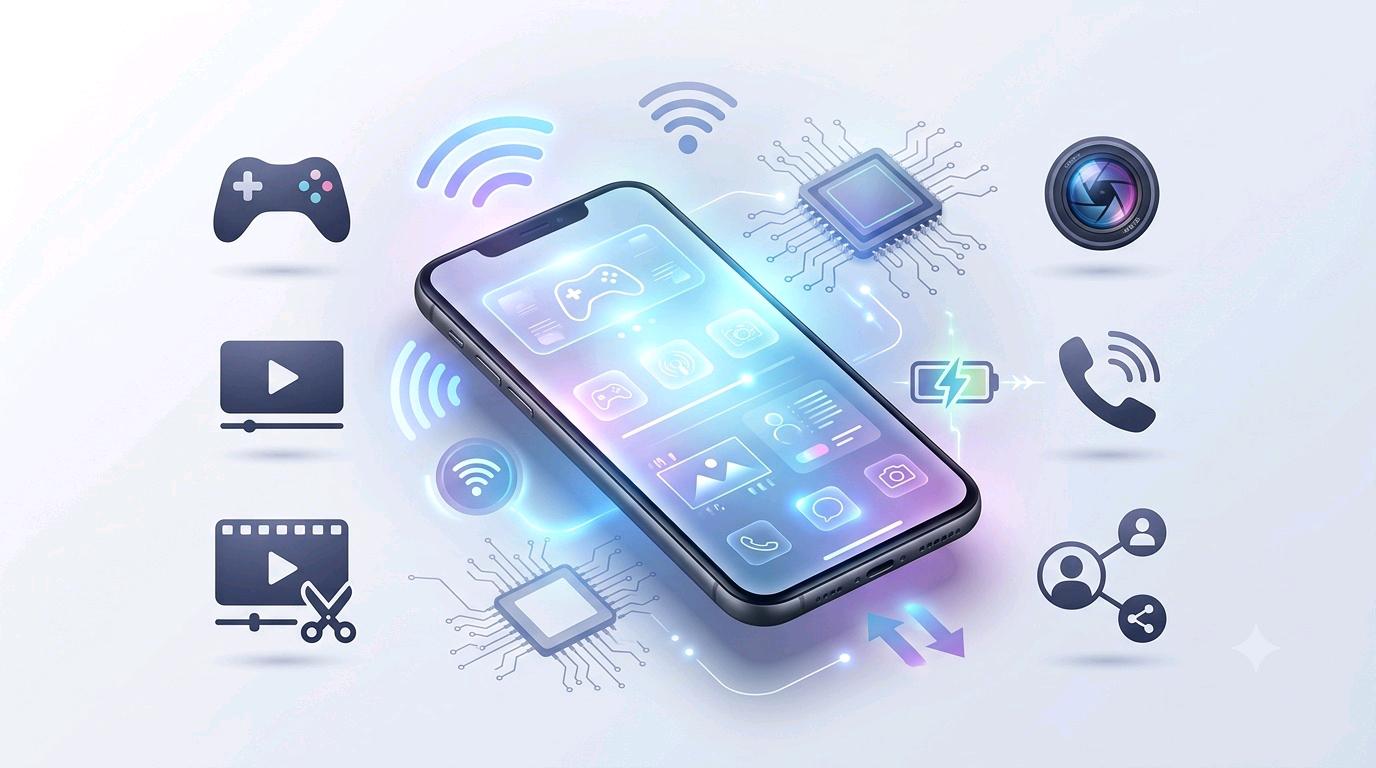
What is a mobile phone? A mobile phone is a portable electronic device that allows people to communicate wirelessly through cellular networks. Modern smartphones can do much more than make calls. They can be used for gaming, watching videos, video editing, photography, internet browsing, online learning and social media. A smartphone combines a processor, memory, display, camera, battery, wireless communication hardware and operating system to provide many computer-like functions in a small device.
What Is a Mobile Phone and How Does It Work?
A mobile phone is a portable electronic communication device designed to send and receive information without requiring a physical connection to a communication network. Traditional mobile phones were mainly designed for voice calls and text messages, while modern smartphones have become powerful multipurpose devices.
When you make a phone call, your voice is captured by the microphone and converted into an electronic and digital signal. The phone then uses radio communication to send the information to a nearby cellular network. The network routes the communication toward the receiving phone. The other phone receives the signal and converts it back into sound through its speaker.
Internet activities work in a similar way. A smartphone can connect to the internet through mobile data or Wi-Fi. The processor, modem, antennas, operating system and applications work together to send and receive digital information.
Main Topics: What Can You Do With a Mobile Phone?
How Does a Smartphone Work?
A smartphone works through the cooperation of several hardware and software components. When you touch the screen, the touchscreen detects your input. The operating system interprets the command and sends it to the appropriate application. The processor then performs the required calculations, and the result appears on the display or is delivered through another component such as the speaker.
For example, when you play an online video, your smartphone receives digital data through the internet connection. The processor and other hardware process and decode the information, while the display shows the images and the speaker produces the audio.
In simple terms: Touchscreen receives input → Software interprets it → Processor processes the instructions → Data comes from storage or the internet → Display, speaker, camera or another component provides the result.
Important Components Inside a Mobile Phone
A smartphone may look like a simple device from the outside, but it contains many electronic components. Each component performs a specific function.
- Processor: Handles calculations and instructions required by apps and the operating system.
- RAM: Provides temporary working memory for active applications and processes.
- Internal Storage: Stores apps, photos, videos, documents and other files.
- Display: Shows text, images, videos, games and other visual information.
- Battery: Supplies electrical power to the phone's components.
- Camera: Captures photos and videos using sensors and lenses.
- Microphone: Captures sound and converts it into a signal that the phone can process.
- Speaker: Produces sound for calls, music, videos and notifications.
- Modem: Helps the smartphone communicate with cellular networks.
- Antennas: Send and receive wireless signals.
- Sensors: Detect movement, light, proximity, orientation and other environmental information.
🎮 Mobile Phone for Gaming
Smartphones have become popular gaming devices. Users can play simple casual games as well as demanding 3D titles on compatible devices. The gaming experience depends on more than just the processor.
If your primary purpose is mobile gaming, factors such as the chipset, GPU, RAM, display refresh rate, touch response, thermal management and battery life can all matter.
What Should You Look for in a Gaming Phone?
- Powerful processor and GPU
- Sufficient RAM
- High-refresh-rate display
- Responsive touchscreen
- Good thermal management
- Long battery life
- Fast charging support
- Enough internal storage
When choosing the best phone for gaming, consider the types of games you actually play. Not everyone needs an expensive flagship or dedicated gaming smartphone.
▶️ Mobile Phone for Watching Videos
A smartphone is one of the most convenient devices for entertainment. You can watch movies, educational videos, short-form content, live streams and other online videos almost anywhere.
For a mobile phone for watching videos, display quality, screen size, brightness, speaker performance, battery life and internet connectivity are important considerations.
Displays such as OLED and AMOLED can provide strong contrast and deep blacks, while good stereo speakers can make movies and other content more enjoyable.
Tip: If watching videos is your main purpose, do not choose a phone based only on its processor or camera. A good display, comfortable screen and quality speakers may have a greater impact on your daily experience.
🎬 Mobile Phone for Video Editing
Modern smartphones can be used for everything from basic video trimming to relatively advanced editing. Mobile video editing apps can provide features such as cutting, transitions, text, filters, effects, audio editing and high-resolution export.
A video editing phone should ideally have a capable processor, strong graphics performance, sufficient RAM and adequate storage. High-resolution video files can consume significant storage space, so storage capacity is particularly important for frequent editors.
Important Features for Mobile Video Editing
- Powerful processor
- Capable GPU
- Enough RAM
- Fast internal storage
- Good-quality display
- Strong battery endurance
- Effective cooling
If you mainly edit short social media clips, you may not need professional-level hardware. More demanding projects involving long or high-resolution footage can benefit from more powerful hardware.
📷 Mobile Phone for Photography
Smartphone photography has made photography accessible and convenient. Modern phones use camera sensors, lenses and computational photography techniques to capture and process images.
When choosing a mobile phone for photography, looking only at megapixel numbers is not enough. Sensor quality, lens quality, autofocus, stabilization, dynamic range, low-light performance and image processing can also affect the final photograph.
Important Smartphone Photography Features
- Good primary camera sensor
- Reliable autofocus
- Optical or electronic stabilization
- Good low-light processing
- HDR support
- Natural image processing
- Useful ultrawide or telephoto camera
A good photograph is not created by camera hardware alone. Lighting, composition, framing and photography skills are also important.
📞 Mobile Phone for Calling
If your main requirement is simply making and receiving calls, you may not need an extremely powerful smartphone. In this situation, call quality, network compatibility, microphone performance, speaker quality and battery life can be more important than gaming or camera specifications.
Modern smartphones also provide messaging, contacts, video calls and internet-based communication alongside traditional cellular calling.
🌐 Mobile Phone for Social Media
Smartphones are convenient tools for staying connected through social media platforms. Users can send messages, share photos and videos, watch content, participate in communities and communicate with friends and family.
For a smartphone for social media, useful features include a good front camera, quality display, reliable internet connectivity, battery life, sufficient storage and smooth app performance.
Privacy Tip: Review app permissions before giving applications access to your camera, microphone, contacts or location. Use strong passwords and two-factor authentication where available to improve account security.
How Can One Mobile Phone Do So Many Things?
A smartphone can be thought of as a small computer that fits in your pocket. The processor performs calculations, RAM handles active tasks, storage keeps your files, and the operating system manages communication between hardware and applications.
Internet connectivity makes smartphones even more powerful because applications can communicate with online services and cloud platforms. This allows one device to perform tasks such as calling, photography, gaming, video editing, entertainment and social networking.
Which Mobile Phone Is Best for Different Uses?
| Purpose | Main Requirement | Important Features |
|---|---|---|
| Gaming | High performance | Processor, GPU, RAM, display, cooling |
| Watching Videos | Entertainment | Display, speakers, battery, connectivity |
| Video Editing | Creative work | Processor, GPU, RAM, storage |
| Photography | Image capture | Sensor, lens, stabilization, processing |
| Calling | Communication | Network, microphone, speaker, battery |
| Social Media | Online communication | Camera, display, battery, internet, storage |
What Should You Check Before Buying a Mobile Phone?
The right smartphone is the one that matches your actual needs. A phone that is excellent for another person may not be the best choice for you.
- Identify your primary use: Gaming, photography, video editing, entertainment or communication?
- Check the processor: Performance matters for demanding applications and games.
- Look at the display: Display quality is especially important for video and gaming users.
- Evaluate the camera: Photography users should consider sensor quality and image processing.
- Consider battery life: Heavy users can benefit from strong battery endurance.
- Check storage: Games, photos and videos can quickly consume storage space.
- Consider software support: Software and security updates can be important for long-term use.
Benefits of Using a Mobile Phone
- Easy communication through calls and messages.
- Quick access to information through the internet.
- Convenient photography and video recording.
- Access to online education and productivity tools.
- Gaming and entertainment.
- Navigation and location-based services.
- Access to digital services and online transactions.
- Connection with social media platforms and online communities.
Things to Keep in Mind While Using a Smartphone
Smartphones are useful technology, but responsible usage is important. Taking regular breaks during long periods of screen use can be helpful. Users should also be careful when installing applications, opening links or sharing personal information online.
- Install apps from trusted sources.
- Use strong passwords for important accounts.
- Enable two-factor authentication where possible.
- Avoid suspicious links and messages.
- Keep backups of important photos and documents.
- Keep your operating system and applications updated.
- Avoid sharing unnecessary personal information online.
Frequently Asked Questions (FAQ)
1. What is a mobile phone?
A mobile phone is a portable electronic communication device that uses wireless networks to make calls, send messages and access other services. Modern smartphones can also be used for gaming, photography, video editing, entertainment and social media.
2. What is the difference between a mobile phone and a smartphone?
Mobile phone is a broad term for portable cellular communication devices. A smartphone generally has an advanced operating system, touchscreen, internet connectivity, applications and computer-like capabilities.
3. How does a mobile phone connect to the internet?
A smartphone can connect to the internet through cellular mobile data or Wi-Fi. The device uses wireless communication hardware to exchange digital information with the network.
4. What is most important in a gaming phone?
Processor performance, GPU capability, RAM, display refresh rate, touch response, thermal management and battery performance are important for gaming.
5. Can a mobile phone be used for professional video editing?
Many modern smartphones and editing applications support advanced video editing. However, complex and very large projects may still be more convenient to handle on a desktop computer or professional workstation.
6. Are more megapixels always better for photography?
No. Megapixels are only one part of a camera system. Sensor quality, lens quality, autofocus, stabilization and image processing can also have a major effect on image quality.
7. Do I need a smartphone if I only want to make calls?
Not necessarily. If your main requirement is voice calling, a basic communication-focused phone may be sufficient. A smartphone becomes more useful when you also need apps, internet access, cameras and other features.
8. What features are useful for social media?
A good display, reliable internet connectivity, battery life, camera quality, sufficient storage and smooth app performance can be useful for social media users.
9. Is a smartphone a small computer?
In many ways, yes. Smartphones have processors, memory, storage, operating systems and applications. However, their hardware and software are designed specifically for mobile use.
Conclusion: A Mobile Phone Is More Than a Calling Device
A mobile phone is no longer just a device for making calls. Modern smartphones can be used for gaming, watching videos, video editing, photography, online learning, internet browsing, entertainment and social media.
If you need a mobile phone for gaming, performance, graphics capability and thermal management may be your priorities. For watching videos, display and speaker quality can be more important. For video editing, processor performance, RAM and storage become particularly useful. For photography, camera sensors, lenses and image processing deserve attention.
The best mobile phone is therefore not necessarily the one with the highest specifications. It is the device that provides the right balance of features, performance, battery life and usability for your particular needs.
Disclaimer: This article is provided for general educational and informational purposes. Smartphone features, performance and capabilities vary between models and software versions. Always check official specifications and consider your personal requirements before purchasing a device.