
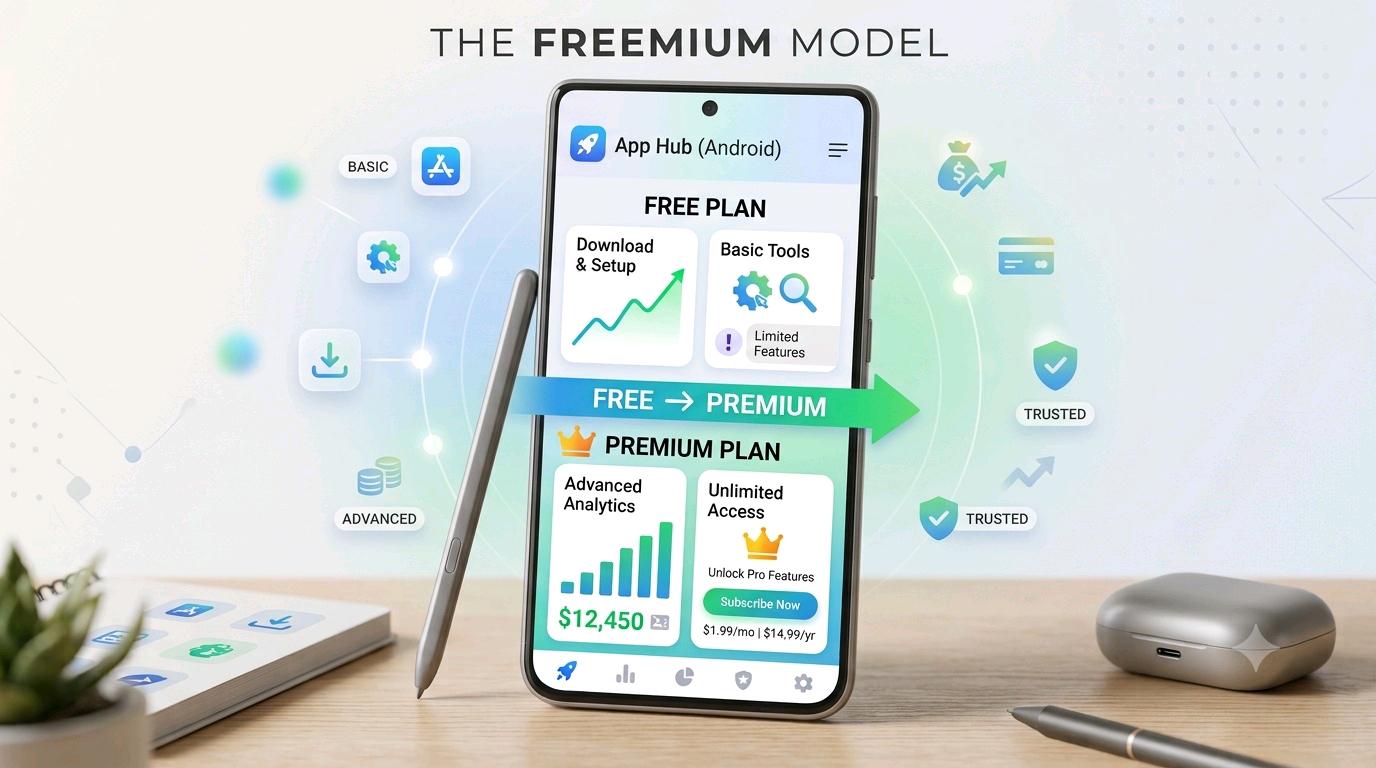
Freemium Model: How Free Apps Make Money From Premium Features
What Is the Freemium Model?
The freemium model is a business model that combines two words: free and premium. Users can access a basic version of a product without paying, while additional features, advanced tools, extra content, or improved services are available through a paid plan.
This approach is particularly common in mobile apps, SaaS products, productivity tools, cloud services, games, educational platforms, and digital services.
The basic idea is simple: give users enough value to start using the product for free, then provide additional value that makes a premium upgrade worthwhile.
How Does the Freemium Business Model Work?
A successful freemium strategy usually follows a simple customer journey:
- Discover: A potential customer finds the product.
- Install or Sign Up: The user starts using the free version.
- Experience Value: The user discovers useful features.
- Reach a Need: The user wants additional functionality.
- See Premium Benefits: Paid features are presented clearly.
- Upgrade: Some users choose a premium plan.
- Retention: The business continues providing value to paying customers.
The most important part is the balance between the free experience and the premium experience. If the free version is too limited, users may leave before understanding its value. If everything is available for free, there may be little reason to upgrade.
Free vs Premium: Finding the Right Balance
| Free Version | Premium Version |
|---|---|
| Core features | Advanced features |
| Basic usage limits | Higher or expanded limits |
| Standard experience | Enhanced experience |
| May include advertisements | May offer an ad-free experience |
| Limited customization | More customization options |
There is no universal formula for deciding what belongs in the free plan. The decision should depend on the product and the value users receive.
What Can Be Offered as Premium Features?
Premium features should provide meaningful additional value. Simply putting an arbitrary restriction on an important feature may frustrate users rather than encourage upgrades.
1. Advanced Features
Basic functionality can remain free while advanced tools are included in the premium version. This works especially well for productivity and professional applications.
2. Higher Usage Limits
A free plan may have reasonable limits, while premium users receive larger storage, more projects, more exports, additional usage or expanded functionality.
3. Ad-Free Experience
Some apps provide the core product for free with advertising and offer a paid option that removes advertisements. The premium version should still provide clear additional value.
4. Customization
Premium users may receive additional themes, layouts, personalization options or other customization features.
5. Cloud and Sync Features
For applications that work across multiple devices, advanced synchronization, backup or cloud-related capabilities can become part of a premium offering.
6. Exclusive Content
Educational apps, content platforms and creative products can offer additional courses, templates, lessons, resources or other digital content through premium plans.
How Does the Freemium Model Make Money?
The free version itself may not directly generate revenue from every user. Instead, the business uses the free audience to create opportunities for premium upgrades, subscriptions, advertising, or other legitimate revenue streams.
Premium Upgrades
The simplest approach is to allow users to upgrade from a free plan to a paid version. The premium plan should clearly explain what the customer receives.
Subscription Revenue
Apps and software that provide continuing value may offer monthly or annual subscriptions. Subscriptions can provide recurring revenue when customers continue receiving useful services.
Advertising
Some free apps generate revenue by displaying advertisements. A premium plan may optionally provide an ad-free experience or other additional benefits.
In-App Purchases
Apps can offer eligible digital products or additional content through supported in-app purchase systems. This model is common in games and digital applications.
Advantages of the Freemium Business Model
1. Lower Barrier to Entry
Users can try the product without making an immediate financial commitment. This can make it easier for a new product to attract initial users.
2. Faster Product Discovery
A free version can make it easier for people to test the product and recommend it to others when they find it useful.
3. Larger Potential User Base
Removing the initial price barrier can increase the number of people who are willing to try a product.
4. Product Feedback
A larger user base can provide valuable feedback about usability, missing features and technical problems.
5. Multiple Revenue Opportunities
A freemium product can potentially combine premium upgrades, subscriptions, advertising and other appropriate revenue streams.
Disadvantages of the Freemium Model
Freemium is not automatically profitable. It also creates challenges that businesses need to understand.
Low Conversion Rate
Many free users may never become paying customers. Therefore, the product needs enough potential premium value to support the business.
Higher Support Requirements
A large free user base can increase customer support, infrastructure and maintenance costs.
Feature Balance Can Be Difficult
If too many useful features are locked behind payment, users may feel restricted. If too many premium features are offered for free, fewer users may upgrade.
Users May Leave
Unexpected restrictions, aggressive advertisements or confusing pricing can reduce user trust and retention.
How to Create a Successful Freemium Strategy
- Define your target audience. Understand who benefits most from the product.
- Identify the core value. Make the free version useful enough to demonstrate the product.
- Choose meaningful premium features. Charge for additional value rather than basic usability.
- Keep pricing understandable. Avoid confusing plans and unclear benefits.
- Show premium benefits at the right time. Do not interrupt users constantly.
- Measure user behavior. Study activation, retention, upgrades and cancellations.
- Improve the product. Use genuine feedback to make both free and premium experiences better.
Freemium Model for Android Apps
The freemium strategy can be especially useful for Android apps because users can often try an application before deciding whether they want additional features.
For example, an app could provide its main functionality for free and offer premium tools, additional customization, expanded limits, subscriptions or other digital benefits.
The important point is that monetization should not destroy the user experience. An app filled with intrusive advertisements or confusing upgrade messages may receive negative feedback and lose users.
Freemium vs Free Trial
| Freemium | Free Trial |
|---|---|
| Basic version remains free | Full or expanded experience is free for a limited period |
| Users can continue using free features | Payment may be required after the trial ends |
| Premium features encourage upgrades | Time limit encourages a purchase decision |
Both models can work, but they serve different customer journeys. A freemium model focuses on a permanent free tier, while a free trial usually gives temporary access to paid functionality.
Common Freemium Mistakes to Avoid
- Making the free version almost unusable.
- Hiding important pricing information.
- Using excessive advertisements.
- Creating too many confusing premium plans.
- Locking essential functionality without a clear reason.
- Making cancellation difficult.
- Ignoring feedback from free users.
- Focusing only on downloads instead of active users and retention.
Frequently Asked Questions
What is a freemium model?
A freemium model provides a basic product or service for free while offering optional premium features, higher limits, additional content or enhanced functionality for paying customers.
Is freemium the same as completely free?
No. A completely free product may not charge users at all, while a freemium product has both a free offering and paid options.
How does a freemium app make money?
A freemium app can make money through premium upgrades, subscriptions, in-app purchases, advertising or other suitable revenue models.
Should every feature be free in a freemium app?
No. The free version should provide genuine value, while premium features should offer additional benefits that users may reasonably want to pay for.
Is the freemium model good for Android apps?
It can be effective for Android apps when the free version is useful and the premium offering provides clear additional value. The best approach depends on the type of app and its audience.
How can I increase premium conversions?
Improve the free experience, identify what users need most, communicate premium benefits clearly, make the upgrade process simple, and continuously test the product based on legitimate user feedback.
Can advertising and freemium be used together?
Yes. Some apps use advertising in the free version and provide a paid option with fewer or no advertisements along with additional premium features.
Final Conclusion
The freemium business model can be a powerful way to grow a digital product while creating opportunities for revenue. Its strength comes from allowing people to experience the product before deciding whether they need premium features.
However, successful freemium products do not simply put random features behind a payment wall. They provide a useful free experience, clear premium benefits, transparent pricing and a smooth user journey.
If you are building an Android app or digital service, focus first on solving a real problem. Once users understand the value of your product, premium features can become a natural part of the business model rather than an obstacle for users.