
🏠 AI Smart House: A Home That Understands, Automates and Helps
Imagine a home where electricity, cleaning, security, water and climate control can work together through AI.
What if your home could do more than simply respond to commands? With the combination of Artificial Intelligence (AI), Internet of Things (IoT), sensors and home automation, future homes could become much more intelligent and efficient.
An AI Smart House could collect information from different sensors, understand what is happening inside the home and then help automate compatible devices and systems. This article explains the concept through a simple AI Smart House prototype.
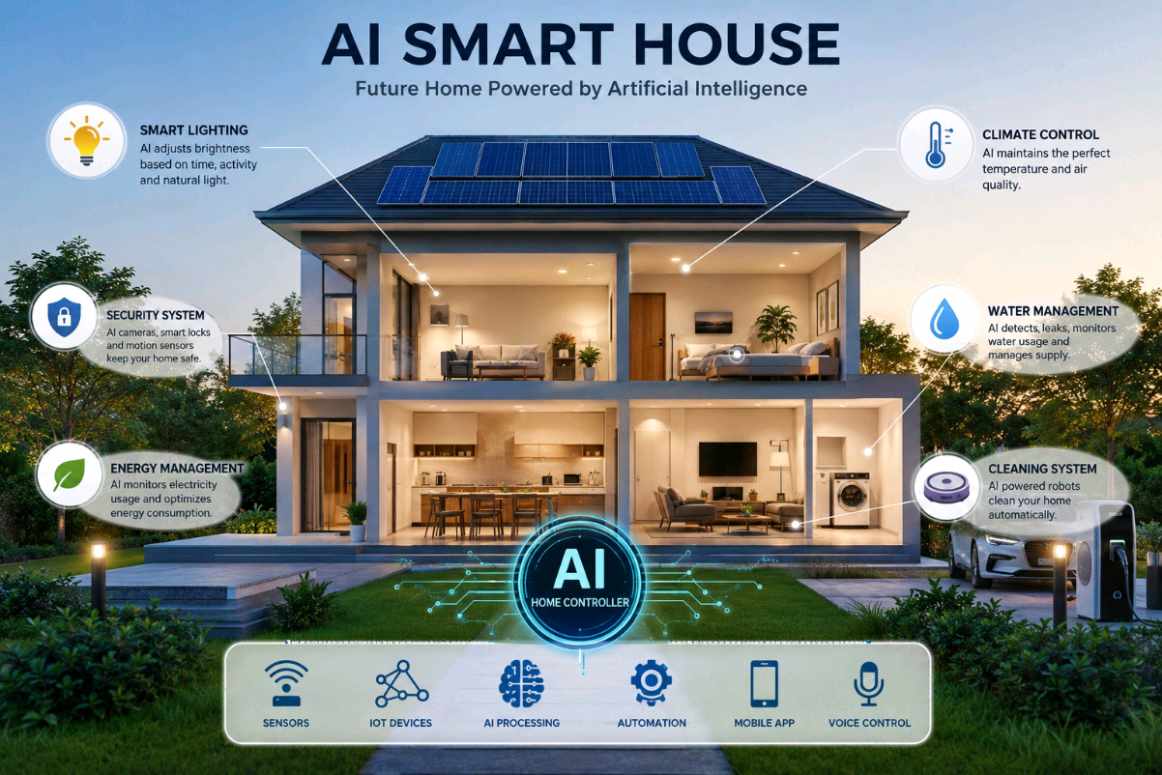
🤖 What Is an AI Smart House?
An AI Smart House is a home where multiple smart devices, sensors, appliances and automation systems can communicate with a central software platform. AI can analyze information from these systems and help make automated decisions according to predefined rules and user preferences.
For example, if a room is empty, the system could turn off compatible lights automatically. If unusual water flow is detected, a smart sensor could send an alert. A cleaning robot could also operate according to a predefined schedule.
🏗️ AI Smart House Prototype
The following conceptual prototype shows how different parts of a future smart home could communicate with an AI-based home controller.
Smart Lighting
Energy System
Cleaning System
Water Management
Security System
Climate Control
Sensors + IoT + Automation
⚡ 1. How Could AI Manage Electricity?
A future smart home could connect smart meters, energy sensors, smart switches, solar panels and compatible appliances to an energy management system.
The system could monitor electricity consumption and identify usage patterns. Depending on the devices and automation rules, it could help reduce unnecessary energy consumption.
Automated lighting based on occupancy, schedules and user preferences.
Monitoring solar generation and household electricity consumption.
Track electricity usage through dashboards and energy reports.
Compatible appliances can be connected to the home automation system.
🧹 2. Can AI Automate Home Cleaning?
Cleaning is another area where smart automation could save time. A future AI home could coordinate compatible cleaning devices such as robot vacuum cleaners and smart cleaning systems.
For example, a robot vacuum could clean different areas according to a schedule. Sensors could help the robot understand its surroundings and avoid obstacles.
In a more advanced setup, multiple cleaning devices could potentially work according to a coordinated schedule.
💧 3. Smart Water Management
Water sensors could monitor water flow, tanks and selected parts of a home's plumbing system.
If a sensor detects unusual water usage, the system could send a notification. This could be useful for detecting possible leaks and monitoring water consumption.
🔐 4. AI-Powered Home Security
An AI Smart House could combine door sensors, motion sensors, cameras, smart locks and alarms into one security platform.
The system could identify unusual activity and notify the homeowner. However, security systems should not rely entirely on AI. Manual controls and reliable emergency procedures are essential.
🌡️ 5. Intelligent Temperature & Air Management
Smart thermostats and environmental sensors can monitor temperature, humidity and other indoor conditions.
An AI-based system could use this information to help control compatible heating, cooling and ventilation devices according to user preferences and predefined rules.
🗣️ 6. Could You Control the House With Your Voice?
Yes, compatible smart home devices can already be controlled through voice assistants. In a future AI home, a conversational AI system could provide a more natural interface for controlling different systems.
For example, a homeowner might say: "Turn off the living room lights."
Or: "Check the cleaning schedule."
Or: "Set the bedroom temperature to my preferred setting."
Important functions should still have physical controls and manual override options.
🧠 How Would AI Understand the House?
The intelligence of an AI Smart House would come from the combination of several technologies rather than from AI alone.
Sensors collect information, IoT devices communicate with one another, the AI software analyzes available information and the automation layer performs permitted actions.
A Simple AI Home Workflow
🌡️ Sensor → Collect Information
⬇
📡 IoT Hub → Connect Devices
⬇
🧠 AI Engine → Analyze Situation
⬇
⚙️ Automation System → Perform Action
⬇
📱 User → Receive Notification / Take Manual Control
🚀 What Could the Future AI House Look Like?
The future home may become more context-aware. Instead of simply following individual commands, an AI system could use information from sensors, schedules, environmental conditions and user preferences to coordinate multiple smart devices.
For example, selected lights could turn on during a morning routine, the energy management system could monitor solar generation and a cleaning robot could start according to its schedule.
The best approach is to think of AI as an intelligent home assistant, not as the owner of the house. Humans should retain control over important and safety-critical decisions.
💰 Would an AI Smart House Be Expensive?
The cost would depend on the size of the house, number of sensors, smart appliances, security equipment, networking infrastructure, solar installation and level of automation.
Instead of automating everything at once, homeowners could gradually add features such as smart lighting, energy monitoring, security sensors, water monitoring and robotic cleaning.
🔒 Privacy and Cybersecurity Are Essential
A highly connected home could generate a large amount of sensitive information. Cameras, microphones and sensors can potentially reveal details about activities inside a home.
Strong passwords, secure networks, software updates, limited permissions, encrypted communication and careful data management can help improve security.
🌟 Final Thoughts
An AI Smart House represents an exciting direction for future home technology. AI, IoT, robotics, smart appliances and automation can work together to make many routine household tasks easier.
Electricity monitoring, lighting, cleaning, security, water management and climate control could become increasingly automated as technology develops.
However, the most successful smart home will not be the one that removes humans from the process completely. It will be the one that provides greater convenience, efficiency, safety and control while keeping people in charge.