
🚁 AI Drone: A Drone That Can Inspect, Return, Recharge and Continue
Could artificial intelligence make autonomous drones capable of repeated inspection missions with automatic charging?
Imagine an intelligent drone that can perform an authorized inspection mission, continuously monitor its battery level, return to a charging station when its battery becomes low, recharge itself and then continue its scheduled task.
This concept is increasingly possible through the combination of Artificial Intelligence (AI), autonomous navigation, computer vision, sensors, robotics, GPS/GNSS, wireless communication and automated docking stations.
The important point is that the drone does not have to be manually controlled throughout the entire mission. With the right hardware, software and safety systems, many routine operations can be automated.
🤖 What Is an AI Drone?
An AI Drone is an unmanned aerial vehicle equipped with software and sensors that allow it to perform certain tasks with a degree of autonomy.
A conventional drone generally depends heavily on a human pilot. An autonomous AI drone, however, can use sensors and onboard computing to understand its surroundings, follow predefined routes, identify certain objects or conditions and make limited decisions according to its programmed mission.
🏗️ AI Drone Prototype: How Would the Complete System Work?
A practical AI drone system would not consist of the aircraft alone. It would work as an ecosystem made up of a drone, sensors, an AI computing system, communication technology and an automated docking station.
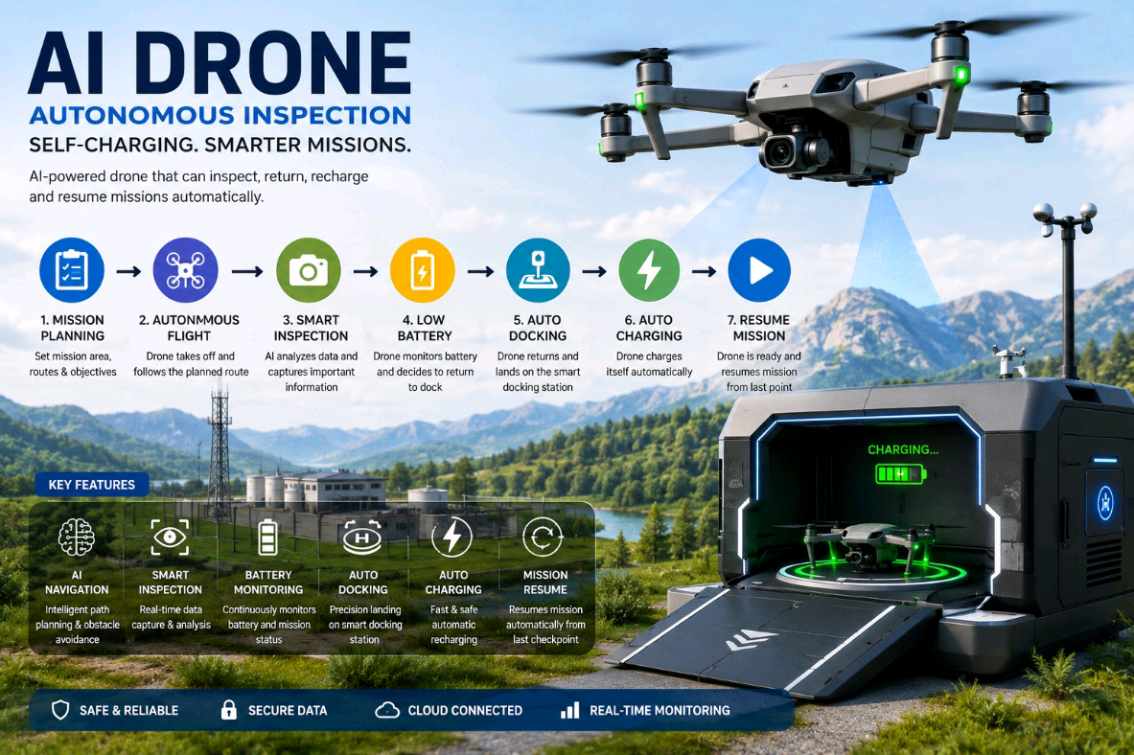
AI Drone Autonomous Mission Workflow
Mission Setup
Autonomous Flight
AI Inspection
Battery Monitoring
Smart Dock
Auto Charging
Resume Mission
🔋 1. Can the Drone Return Automatically When the Battery Is Low?
Yes, this is one of the key concepts behind autonomous drone operations. A drone can monitor its battery state and use predefined safety thresholds to decide when it should return to its home or docking location.
A sophisticated system can consider factors such as remaining battery capacity, distance from the dock, estimated flight time, weather conditions and the energy required for the return journey.
The exact behavior depends on the drone hardware and software. A responsible system should always prioritize a safe return rather than attempting to complete a mission with insufficient energy.
🏠 2. What Is an Automatic Drone Dock?
An automated drone dock is a protected station where a compatible drone can land, recharge and potentially perform automated pre-flight checks.
Navigation and landing systems can help the drone align with its designated docking area.
The dock can recharge a compatible drone without requiring someone to connect a charger manually.
A smart dock can support checks of battery, communication and other operational conditions.
After charging and safety verification, the system may allow an authorized mission to continue.
🧠 3. How Does AI Help the Drone?
AI can provide the software intelligence needed for several parts of an autonomous drone system. Depending on the application, computer vision and machine-learning models can help analyze images and sensor information.
For example, an inspection drone could compare newly captured images with previous inspection data to identify possible changes that require human review.
AI can also assist with route planning, obstacle awareness, image analysis and mission scheduling. However, AI decisions should remain within clearly defined safety and operational limits.
👁️ 4. Can an AI Drone Inspect a Sensitive Area?
An AI drone can potentially be used for authorized inspection and monitoring of restricted or sensitive locations, such as industrial facilities, infrastructure, disaster-affected areas or large private properties where drone operation is legally permitted.
For example, an authorized operator could use a drone to inspect infrastructure for visible damage, monitor environmental conditions or check large industrial facilities without sending people into potentially hazardous areas.
📷 5. AI Camera and Computer Vision
One of the most useful components of an AI drone is its camera and computer-vision system.
Instead of simply recording everything, an AI-assisted inspection system can analyze images and highlight predefined conditions for human review.
Possible legitimate applications include:
Inspect large structures, roofs, towers and industrial infrastructure.
Support visual inspection of bridges, roads and other infrastructure.
Analyze crops and identify areas that may need attention.
Help collect visual information from areas affected by natural disasters.
📡 6. What Happens If Communication Is Lost?
A reliable autonomous drone should never depend on continuous communication alone. It should have predefined failsafe behavior for situations such as communication loss, navigation problems or low battery.
Depending on the system design, the drone may enter a safe state, return to its designated location or land at an approved safe location.
The exact behavior must be designed and tested by qualified professionals according to the drone's hardware, operating environment and applicable aviation rules.
🔄 7. Can It Automatically Resume the Mission After Charging?
In principle, yes. An appropriately designed autonomous system can store mission progress and determine whether a scheduled task should continue after the drone has recharged.
For example:
Mission A: Inspect an authorized area.
⬇
Battery Low: Mission pauses safely.
⬇
Return: Drone navigates to its authorized dock.
⬇
Charging: Battery recharges.
⬇
Safety Check: System verifies operational conditions.
⬇
Resume: Mission continues only if authorized and safe.
This is one of the most interesting possibilities of AI drone technology: persistent automated inspection, where the system can repeat routine monitoring without requiring a person to manually fly the drone every time.
☁️ 8. AI Drone + Cloud Dashboard
A complete system could include a dashboard where an authorized operator can view the drone's status, battery level, mission progress, alerts, inspection results and maintenance information.
The dashboard could also allow a human operator to pause or cancel a mission when necessary.
🛡️ 9. Why Human Control Is Still Important
Even highly autonomous drones should not be treated as completely independent machines. Weather, unexpected obstacles, technical failures and changes in the operating environment can create situations that automated systems may not handle perfectly.
A robust AI drone system should therefore include human oversight, emergency controls, geofencing, authentication, privacy protection and clear operational limits.
🚀 The Future of AI Drone Technology
The combination of AI, robotics and automated docking could make drones useful for repeated inspection tasks where regular human flight control is inefficient or difficult.
In the future, fleets of authorized drones could potentially be managed through centralized software. The system could schedule missions, monitor battery status, coordinate charging and present inspection results to human operators.
The most important development will not simply be making drones fly by themselves. The real challenge is creating systems that are safe, reliable, secure, legally compliant and easy for humans to supervise.
🌟 Final Thoughts
Yes, the basic concept of an AI Drone that performs an authorized inspection, monitors its battery, returns to an automated dock, recharges and resumes its scheduled work is technically achievable in principle using existing categories of technology.
The complete system requires much more than AI alone. It needs autonomous navigation, sensors, computer vision, reliable communications, battery management, an automated docking station, safety mechanisms and appropriate human oversight.
As these technologies continue to develop, AI drones could become valuable tools for infrastructure inspection, industrial monitoring, agriculture, environmental observation and disaster assessment.