
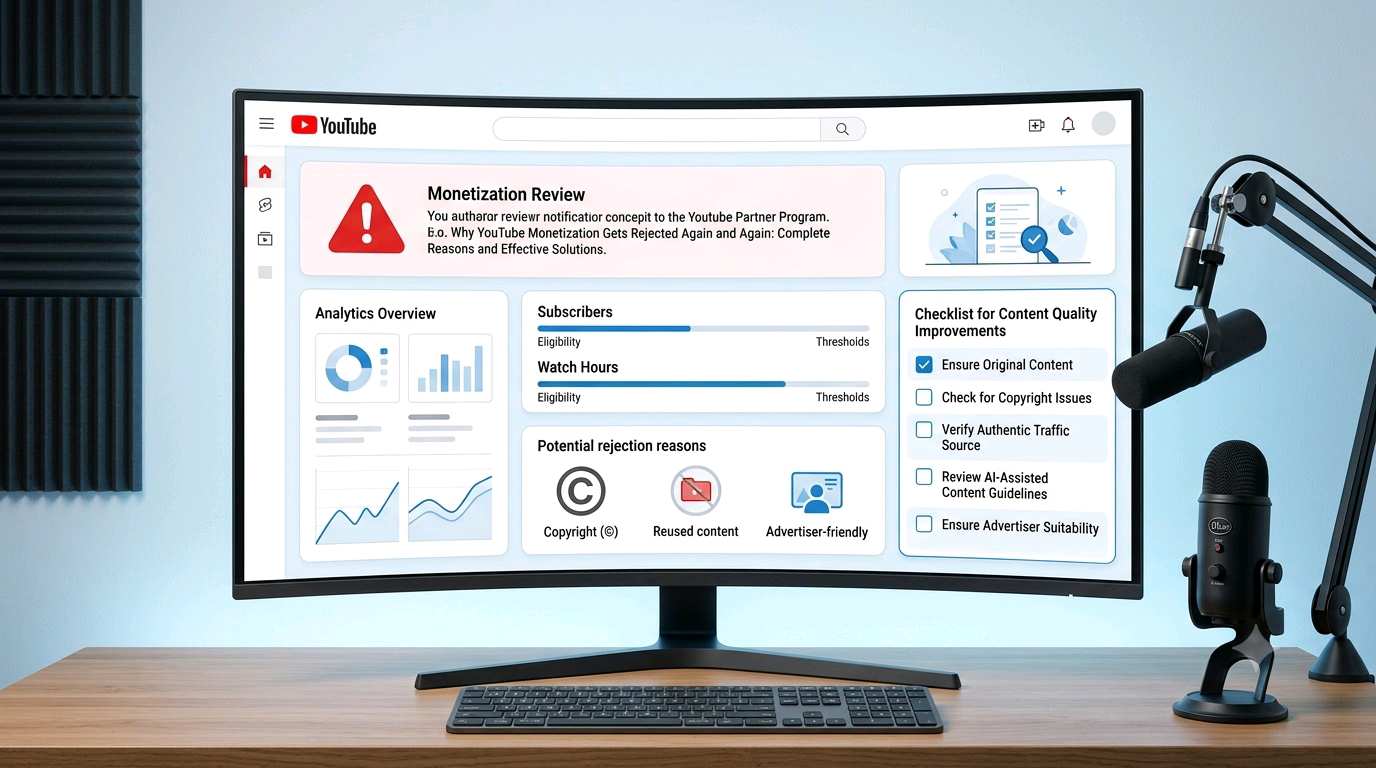
YouTube monetization rejection can be frustrating, especially when a channel has already reached the required eligibility milestones. However, monetization is not decided only by subscribers, watch time or views. YouTube evaluates a channel according to its monetization policies, content quality, originality, authenticity, copyright compliance, advertiser suitability and other requirements. A channel can therefore be rejected even after achieving the required numbers. This complete guide explains the major reasons YouTube monetization may be rejected repeatedly and, more importantly, what creators can do to fix each problem. From reused content and repetitive videos to copyright, artificial traffic, misleading metadata, AI-assisted content and channel-wide quality issues, this guide covers the important areas creators should review before applying again.
Why Does YouTube Monetization Get Rejected Again and Again?
Getting enough subscribers and watch hours is only one part of becoming eligible for the YouTube Partner Program. Meeting the eligibility threshold does not automatically guarantee monetization approval. YouTube reviews the channel and its content to determine whether it follows the applicable monetization policies.
This is why repeatedly submitting the same channel without making meaningful improvements may lead to another rejection. The better approach is to understand the rejection reason, audit the complete channel and correct the underlying problems before applying again.
Complete Guide to Fix Repeated YouTube Monetization Rejection
There can be more than one reason behind a monetization rejection. Sometimes the problem is obvious, such as reused content or a copyright issue. In other cases, the problem may be related to repetitive production, low viewer value, misleading metadata, artificial traffic, advertiser suitability or channel-wide quality.
The important thing is to identify the actual weakness instead of making random changes. The following sections explain each major area and provide practical steps for improving it.
- Loading posts...
1. Lack of Original Content
One of the most important factors in a monetization review is whether the channel provides meaningful original value. If most videos simply reproduce information, footage or ideas from other sources without sufficient creator contribution, the channel may have difficulty demonstrating originality.
How to Fix It
- Create original videos, demonstrations, tutorials or explanations.
- Add your own research and analysis.
- Use original screen recordings where appropriate.
- Explain information in your own structure and words.
- Add examples that make the content more useful.
- Give viewers a clear reason to watch your version instead of another version.
2. Reused Content
Reused content is one of the most common areas creators should examine after a monetization rejection. Using material created by other people without adding enough meaningful original value can create monetization problems.
Examples can include compilations, copied clips, social-media videos, movie or television footage, collections of other people's content and other third-party material where the creator contribution is minimal.
Effective Solution
- Use your own footage whenever possible.
- Add meaningful commentary and analysis when third-party material is legitimately used.
- Make your explanation the main value of the video.
- Do not simply join several clips together.
- Review older videos as well as recent uploads.
3. Repetitive or Mass-Produced Content
A channel can also become weak when many videos are almost identical. Changing only the title, topic or a few images while keeping the same production pattern may make the channel appear repetitive or mass-produced.
Signs of Repetitive Content
- Almost identical scripts.
- The same narration structure in every video.
- Nearly identical visuals.
- Very little new information from one video to another.
- Large numbers of videos created with minimal variation.
How to Fix It
- Give every video a different purpose.
- Research each topic separately.
- Use different examples and explanations.
- Include original demonstrations.
- Focus on usefulness rather than upload quantity.
4. AI-Generated or AI-Assisted Content With Little Added Value
Using AI tools does not automatically mean a channel cannot be monetized. The bigger concern is the final content. If videos are automatically produced at scale with generic scripts, generic visuals and minimal meaningful creator involvement, the channel may appear repetitive or low-value.
How to Improve AI-Assisted Videos
- Use AI for research, brainstorming or drafting rather than blindly publishing output.
- Fact-check important information.
- Add your own analysis and examples.
- Use original visuals, demonstrations or screen recordings.
- Edit the final script so that it genuinely answers the viewer's question.
5. Copyright Problems
Copyright is another major reason creators should carefully audit their channels. Having access to a video, image or song does not automatically mean that it can be commercially used in a monetized video.
Common Copyright Risks
- Music without suitable commercial rights.
- Movie and television footage.
- Sports footage without appropriate rights.
- Images copied from websites.
- Other creators' videos.
- Stock assets used outside their license terms.
How to Fix Copyright Issues
- Create your own media whenever possible.
- Use properly licensed music and visual assets.
- Keep proof of licenses and permissions.
- Check whether the license allows commercial use.
- Do not assume that simply giving credit gives you commercial rights.
6. Advertiser-Unfriendly Content
Monetization and full advertising suitability are related but not exactly the same thing. Individual videos can have limited advertising even when a channel is part of YPP.
Creators should therefore review content for areas such as inappropriate language, violence, shocking material, adult themes, harmful or unreliable content, hateful or derogatory material, drugs, dangerous activities and other advertiser-sensitive subjects.
How to Improve Advertiser Suitability
- Use accurate and non-shocking thumbnails.
- Avoid unnecessary offensive language.
- Provide context when discussing sensitive subjects.
- Do not exaggerate sensitive topics for clicks.
- Review titles, thumbnails and descriptions along with the video itself.
7. Misleading Titles and Thumbnails
A thumbnail can attract attention without misleading viewers. Problems arise when the title or thumbnail promises something that the video does not actually deliver.
Fix These Problems
- Make the title accurately represent the video.
- Use genuine images or graphics.
- Avoid fake results.
- Do not promise impossible outcomes.
- Remove unnecessary keyword stuffing.
8. Fake Subscribers, Views and Engagement
Artificial engagement is a serious risk. Buying subscribers, views, watch time or engagement may produce numbers, but it does not create a genuine audience and can create monetization problems.
Never Use
- Purchased subscribers.
- Purchased views.
- Automated watch time.
- Artificial likes or comments.
- Services promising guaranteed monetization.
9. Invalid or Suspicious Traffic
Creators should also pay attention to unusual traffic patterns. Artificial traffic and invalid activity can create problems for monetization and advertising systems.
How to Protect Your Channel
- Never click your own advertisements.
- Never encourage viewers to click ads.
- Avoid suspicious traffic services.
- Monitor unusual traffic spikes.
- Do not use automated systems to generate views.
10. Community Guidelines Problems
A channel must also comply with YouTube's Community Guidelines and other applicable policies. Creators should check the channel for warnings, strikes and repeated policy problems before applying again.
What to Do
- Check the YouTube Studio dashboard.
- Review any previous warnings or restrictions.
- Understand why a particular video was restricted.
- Avoid repeatedly uploading similar problematic content.
11. Low-Value Videos
Some channels contain technically original videos but provide very little useful information. Generic slideshows, extremely short explanations, repeated facts and copied summaries can make a channel less valuable to viewers.
Add More Value
- Answer the viewer's complete question.
- Explain why something matters.
- Show how something works.
- Add examples.
- Compare alternatives where useful.
- Use practical demonstrations.
12. Faceless Channels Are Not Automatically a Problem
A channel does not necessarily need to show the creator's face to provide valuable content. Educational, tutorial, technology, documentary and many other channels can work without showing the creator.
The important point is that the content should demonstrate meaningful creator contribution and should not simply be a collection of automatically produced or copied material.
13. Compilation Channels Need Extra Care
Compilation channels can face additional challenges because simply collecting material from different sources may not demonstrate enough original value.
Better Approach
- Build the video around your own commentary.
- Add meaningful analysis.
- Use third-party material only when you have the necessary rights.
- Make the educational or analytical contribution the main part of the video.
14. Shorts Can Also Have Monetization Problems
Short-form videos are not exempt from YouTube's monetization and content policies. A Shorts channel can still face issues involving reused material, repetitive production, copyright, artificial engagement or other policy violations.
Therefore, producing a large number of nearly identical Shorts is not a reliable monetization strategy.
15. Review the Entire Channel, Not Only New Videos
One of the biggest mistakes creators make is improving only their latest videos. A monetization review can consider the channel as a whole, so older videos can also be important.
Channel Audit
- Check your most-viewed videos.
- Check your newest uploads.
- Review videos responsible for significant watch time.
- Look for repeated formats.
- Identify third-party material.
- Review thumbnails and titles.
- Check copyright and policy history.
16. AdSense and Account Setup
Creators should also verify that their account setup meets the requirements shown in YouTube Studio. This can include account security, advanced features, AdSense for YouTube association and other eligibility conditions.
Check These Areas
- Open the Earn section in YouTube Studio.
- Check two-step verification.
- Check advanced features access.
- Verify the correct AdSense for YouTube setup.
- Follow the instructions displayed for your account.
17. Do Not Reapply Without Fixing the Problem
If the same channel is rejected and nothing meaningful has changed, simply applying again is unlikely to solve the underlying problem.
18. What to Do Before Reapplying
| Area | What to Fix |
|---|---|
| Originality | Create content with meaningful original research, explanation and presentation. |
| Reused Content | Reduce dependence on third-party material and add substantial original value where permitted. |
| Repetitive Content | Make videos genuinely different in purpose, information and presentation. |
| Copyright | Use original or properly licensed audio, video and images. |
| Traffic | Stop artificial views, subscribers and engagement. |
| Metadata | Use accurate titles, descriptions and thumbnails. |
| Advertiser Suitability | Review videos and metadata for advertiser-friendly issues. |
| Channel Quality | Improve weak, repetitive and low-value videos throughout the channel. |
| AdSense | Check the account and monetization setup in YouTube Studio. |
19. Should You Delete Old Videos?
Do not automatically delete every old video after a rejection. First identify which content is actually problematic and understand whether you are preparing for a new application or submitting an appeal.
If you are appealing a decision, follow YouTube's specific appeal instructions rather than making unnecessary changes immediately before the appeal.
20. Appeal or Reapply?
| Situation | Recommended Direction |
|---|---|
| You believe the decision is incorrect | Review the appeal option available in YouTube Studio and explain your channel's compliance clearly. |
| Your channel genuinely has policy issues | Make meaningful improvements before reapplying. |
| Reused content is the main issue | Increase original creator contribution and reduce dependence on borrowed material. |
| Copyright is the problem | Resolve rights issues and use appropriate licensed or original assets. |
| Artificial traffic is involved | Stop the activity and focus on genuine audience growth. |
21. How to Build a More Monetization-Friendly Channel
A strong channel should clearly show what the creator contributes. That contribution can come through original research, narration, demonstrations, testing, screen recordings, tutorials, interviews, comparisons, original graphics or detailed analysis.
Original idea + useful research + meaningful explanation + authentic presentation + genuine viewer value = a stronger monetization-ready channel.
22. Mistakes to Avoid After Monetization Rejection
- Do not buy subscribers.
- Do not buy watch hours.
- Do not buy views.
- Do not copy scripts from other channels.
- Do not upload large numbers of almost identical videos.
- Do not rely heavily on third-party clips.
- Do not assume credit automatically solves copyright.
- Do not use misleading thumbnails.
- Do not ignore old videos.
- Do not reapply without fixing the main problem.
- Do not depend entirely on automated content production.
23. Final YouTube Monetization Checklist
- ☑ My videos provide genuine viewer value.
- ☑ My content is substantially original.
- ☑ My channel is not mainly based on reused content.
- ☑ My videos are not mass-produced with minimal variation.
- ☑ I have appropriate rights for audio and visual assets.
- ☑ My titles and thumbnails accurately represent the content.
- ☑ My traffic is genuine.
- ☑ I do not manipulate views, subscribers or engagement.
- ☑ My channel follows Community Guidelines.
- ☑ My AdSense setup is correct.
- ☑ I have reviewed the channel as a whole.
- ☑ I have fixed the reason for the previous rejection.
Conclusion: How to Stop Repeated YouTube Monetization Rejection
Repeated YouTube monetization rejection should not be viewed simply as a subscriber or watch-time problem. A channel can reach the required numbers and still fail review if its content has problems related to originality, reused material, repetitive production, copyright, advertiser suitability, artificial traffic, misleading metadata or other policy requirements.
The most effective long-term solution is to create a channel that clearly demonstrates original content, meaningful creator contribution, genuine audience activity, proper rights and useful information.
Instead of repeatedly applying with the same content, use the rejection as a signal to conduct a complete channel audit. Fix the actual weaknesses, improve the quality of the content and then use the current information shown in YouTube Studio before applying again.
Frequently Asked Questions About YouTube Monetization Rejection
Why is YouTube monetization rejected even after reaching the required watch hours?
Eligibility numbers are only one part of the process. YouTube also reviews the channel for compliance with its monetization policies and other requirements.
Can a faceless YouTube channel be monetized?
Yes, a faceless format is not automatically a monetization violation. The content still needs to provide original, useful and policy-compliant value.
Does using AI automatically cause monetization rejection?
AI use itself should not be treated as the only issue. The finished content should provide meaningful value and should not be repetitive or mass-produced with little creator contribution.
Can reused content be monetized?
Simply reusing third-party content without sufficient original value can create monetization problems. Meaningful original commentary, analysis or transformation may be relevant, but creators must also consider copyright and commercial-use rights.
Should I buy subscribers or watch hours?
No. Artificial engagement and invalid traffic can create serious problems. Genuine audience growth is the safer long-term approach.
What should I do immediately after monetization rejection?
Read the rejection information in YouTube Studio, identify the relevant policy area, audit the channel, improve the affected content and then use the available appeal or reapplication process when appropriate.
Can changing thumbnails alone fix monetization rejection?
It may help if misleading metadata is part of the problem, but it will not fix deeper issues such as reused, repetitive, copyrighted or low-value content.
Should I delete all old videos?
No. Do not delete everything blindly. First understand the reason for the rejection and whether you are appealing or preparing for a future application.