
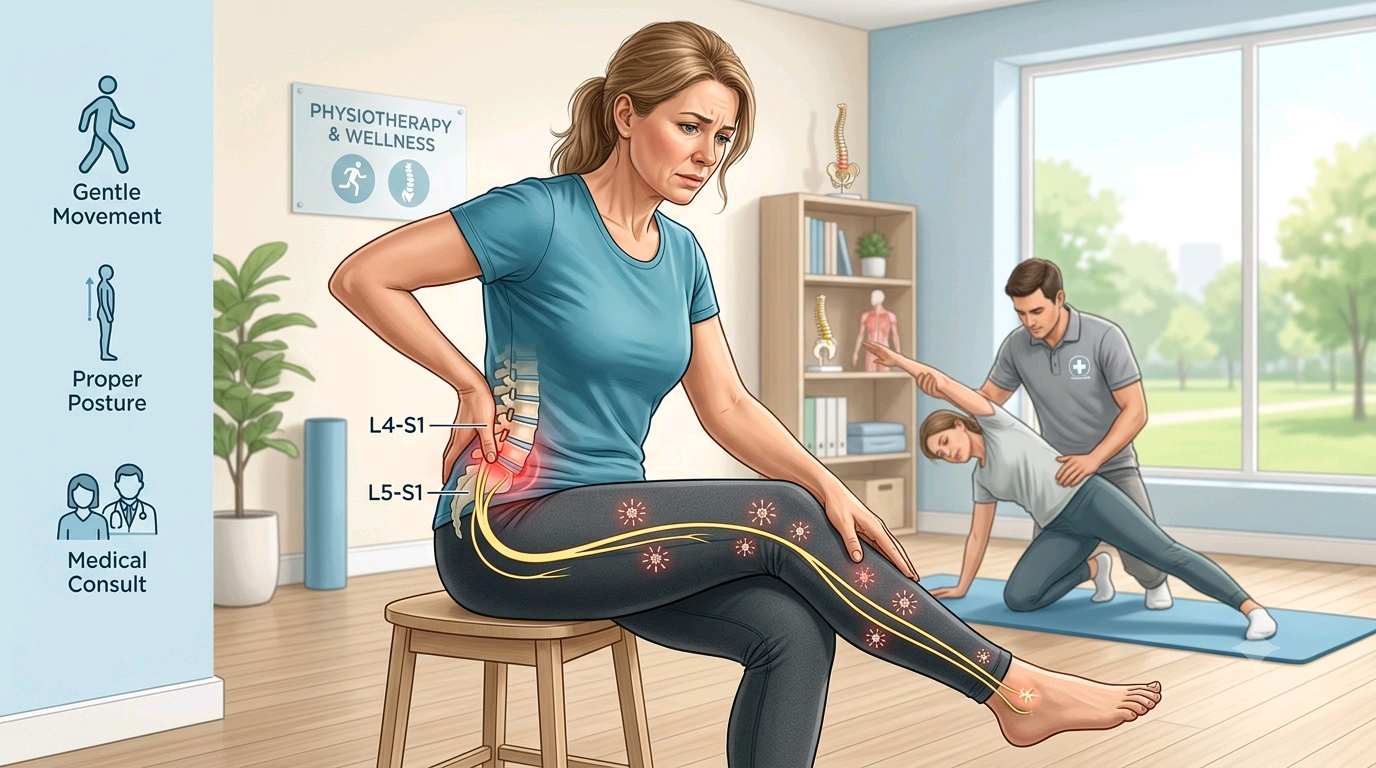
Sciatica is a nerve-related condition in which pain, tingling, numbness, or weakness may travel from the lower back or buttock into one leg. It commonly happens when a nerve root in the lower spine becomes irritated or compressed. A disc problem is one possible cause, but other spinal conditions can also produce similar symptoms. Sciatica can make sitting, standing, walking, bending, and sleeping uncomfortable. Many cases improve with appropriate treatment and gradual return to normal activity, but severe or worsening symptoms should not be ignored. This guide explains how sciatica develops, why it can affect one side of the body, what precautions may be useful, how medicines should be handled safely, which activities may aggravate symptoms, and when professional or urgent medical assessment is necessary.
Sciatica: Causes, Symptoms, Treatment, Precautions and Recovery
Sciatica is commonly used to describe pain and other nerve-related symptoms that travel along the pathway of the sciatic nerve. The symptoms often begin in the lower back or buttock and continue into one leg. Some people experience sharp or burning pain, while others notice tingling, pins and needles, numbness, or weakness.
One important point is that sciatica is a symptom rather than a single disease. Different conditions can irritate or compress a nerve root. Therefore, treatment should depend on the cause, severity, duration, and individual health situation.
For many people, symptoms gradually improve with appropriate self-care and conservative treatment. However, severe weakness, significant numbness, bladder or bowel changes, or other serious symptoms require prompt medical attention.
Understanding Sciatica Before Starting Treatment
Sciatica can be surprisingly severe. A person may have only mild lower-back discomfort but experience considerable pain in the buttock, thigh, calf, or foot. This happens because irritated nerve tissue can produce symptoms along the nerve's pathway.
The condition may also affect normal walking and daily activities. Sitting for a long time, bending, lifting, coughing, or certain movements can sometimes make symptoms worse.
- Loading posts...
What Is Sciatica?
The sciatic nerve is a large nerve pathway that travels from the lower spine toward the buttock and leg. Sciatica occurs when a nerve root in the lower back becomes irritated or compressed, causing symptoms that can travel into the leg.
Because a particular nerve root may be affected on one side, sciatica frequently produces symptoms in only one leg.
Common Symptoms
- Pain travelling from the lower back or buttock into the leg.
- Sharp, shooting, burning, or electric-like pain.
- Tingling or pins and needles.
- Numbness in part of the leg or foot.
- Weakness in the affected leg or foot.
- Pain that becomes worse with certain movements.
Why Does Sciatica Usually Affect One Leg?
The lower spine contains several nerve roots. When one nerve root becomes irritated or compressed, symptoms can follow the pathway of that particular nerve.
If the affected nerve root is on one side, the pain or abnormal sensation may mainly occur in the corresponding leg. This is why one person may have strong symptoms in the right leg while the left leg remains relatively normal.
Symptoms involving both legs, especially when combined with weakness or bladder and bowel changes, are more concerning and require urgent assessment.
How Does Sciatica Develop?
Sciatica can develop for several reasons. The common mechanism is irritation or compression of a nerve root in the lower spine.
1. Disc Bulge or Herniation
The discs between the bones of the spine act as cushions. Sometimes part of a disc protrudes and irritates a nearby nerve root. This is one of the common causes of sciatica.
2. Narrowing Around the Nerves
The spaces through which spinal nerves travel can become narrower. Reduced space around a nerve may contribute to irritation or compression.
3. Changes in the Spine
Age-related structural changes, bone growth, or other changes around the spine can sometimes affect the space available for nerves.
4. Injury
Certain injuries may cause inflammation or structural changes around the lower spine and contribute to nerve irritation.
5. Other Conditions
Not every case of pain travelling down a leg is caused by ordinary sciatica. Other spinal, nerve, joint, or medical conditions may produce similar symptoms.
What Can Increase the Risk of Sciatica?
- Long periods of inactivity.
- Repeated heavy physical work.
- Sudden or poorly managed lifting.
- Low levels of physical activity.
- Previous episodes of back pain.
- Age-related spinal changes.
- Repeated activities that aggravate the lower back.
How Is Sciatica Usually Treated?
Treatment depends on the cause, severity, duration, and individual circumstances. Many people improve with non-surgical care, while some require additional medical or specialist treatment.
1. Appropriate Physical Activity
Remaining appropriately active is generally an important part of recovery. Prolonged bed rest is usually not considered the best approach for uncomplicated sciatica.
However, staying active does not mean forcing yourself through severe pain. Activity should be adjusted according to symptoms.
2. Physiotherapy and Exercise
A physiotherapist can assess movement and recommend exercises according to the individual's condition. Treatment may focus on mobility, strength, posture, functional movement, and gradual return to normal activities.
There is no single exercise that is suitable for everyone with sciatica.
3. Medicines
A doctor or pharmacist may recommend medicines depending on the person's symptoms, medical history, other medicines, and possible risks.
If you are already taking prescribed medicine, do not increase, decrease, stop, or replace it on your own. Follow the instructions provided by your healthcare professional.
If the medicine causes troublesome side effects or does not appear to help, contact the healthcare professional who recommended it.
4. Heat or Cold
Some people find heat or cold helpful for temporary symptom relief. Protect the skin and avoid prolonged exposure.
Extra care is needed when an area has reduced sensation because excessive heat or cold may not be noticed immediately.
5. Specialist Treatment
If symptoms remain severe, persist for a long time, or cause significant neurological problems, further medical assessment may be required.
Imaging such as MRI is not automatically necessary for every person with sciatica. A healthcare professional may recommend imaging when the result could change treatment decisions.
If You Are Taking Medicine for Sciatica, Are Precautions Important?
Yes. However, precautions do not mean that every person needs the same food restrictions or complete bed rest.
The most important precaution is to follow the treatment instructions given by your doctor or pharmacist.
| Precaution | Why It Matters |
|---|---|
| Follow the prescribed dose | Taking more medicine does not necessarily speed up recovery and may increase the risk of side effects. |
| Do not self-medicate repeatedly | Different medicines have different risks and may not be appropriate for every person. |
| Tell your doctor about other medicines | Some medicines can interact with other medicines or health conditions. |
| Follow activity advice | Appropriate movement is generally an important part of recovery. |
| Avoid prolonged bed rest | Long periods of inactivity can increase stiffness and make returning to normal activity harder. |
| Report significant side effects | A healthcare professional can decide whether treatment needs adjustment. |
Does Sciatica Require a Special Diet?
There is no universal food restriction that cures sciatica or removes nerve compression. The main issue is usually identifying and managing the underlying cause.
A balanced diet can support general health, but it should not be presented as a replacement for appropriate medical care.
If a doctor has given dietary instructions because of another medical condition or a particular medicine, those instructions should be followed.
What Should You Avoid During a Sciatica Flare-Up?
Avoid Long Periods of Sitting
Sitting continuously for a long time may aggravate symptoms in some people. Change position regularly and take comfortable movement breaks.
Avoid Heavy Lifting When It Increases Symptoms
If lifting clearly increases leg pain, tingling, or back pain, reduce that activity and seek professional guidance.
Avoid Sudden Twisting
Rapid twisting or awkward bending can aggravate an already sensitive lower back.
Avoid Aggressive Exercises
Do not perform forceful stretching, intense spinal movements, or heavy exercise simply because an online video claims it will provide a quick cure.
Avoid Prolonged Bed Rest
Extended bed rest is generally not recommended as the main recovery strategy for uncomplicated sciatica.
Can Walking Help With Sciatica?
Walking can be a useful form of gentle movement for many people, provided it does not significantly worsen symptoms.
The aim is not to walk a fixed distance regardless of pain. Start at a comfortable level and gradually increase activity as symptoms allow.
If walking is extremely difficult because of weakness, severe pain, or balance problems, medical assessment is more appropriate than forcing yourself to continue.
Is Complete Bed Rest Necessary?
Usually, prolonged bed rest is not the preferred strategy for uncomplicated sciatica. Appropriate movement and continuation of normal activities as tolerated are generally encouraged.
In severe cases, activity may temporarily need to be reduced. The appropriate level should depend on symptoms and professional advice.
What Can Help You Recover as Quickly and Safely as Possible?
There is no guaranteed instant cure for sciatica. Recovery depends on the cause and severity. Many cases improve over several weeks, although some can last longer.
Step 1: Understand Your Symptoms
Pay attention to where the pain travels and whether you have tingling, numbness, or weakness.
Step 2: Reduce Major Aggravating Activities
Temporarily reduce activities that clearly increase symptoms.
Step 3: Keep Moving Within Your Limits
Change position regularly and maintain comfortable everyday movement.
Step 4: Follow Your Treatment Plan
Take prescribed medicines according to instructions and attend recommended medical or physiotherapy appointments.
Step 5: Increase Activity Gradually
As symptoms improve, gradually return to normal activities rather than immediately returning to heavy work or intense exercise.
Step 6: Watch for Warning Signs
New or worsening weakness, significant numbness, bladder or bowel changes, or numbness around the genital or anal area require urgent medical attention.
Sciatica Recovery: What to Do and What to Avoid
| Helpful Approach | Avoid |
|---|---|
| Gentle regular movement | Long periods of complete inactivity |
| Gradual return to normal activity | Suddenly lifting heavy loads |
| Following professional advice | Changing medicine doses without advice |
| Regular position changes | Remaining in one painful position for a long time |
| Appropriate physiotherapy | Forceful stretching or aggressive exercises |
| Monitoring weakness and numbness | Ignoring worsening neurological symptoms |
When Should You See a Doctor for Sciatica?
Medical assessment is appropriate when pain is severe, keeps getting worse, interferes significantly with daily activities, or does not improve with reasonable self-care.
You should also seek medical advice if you develop noticeable weakness, persistent numbness, or difficulty walking.
A healthcare professional can determine whether the symptoms are actually caused by sciatica and whether another condition needs to be considered.
Sciatica Warning Signs That Need Urgent Medical Attention
Do not wait for routine treatment if serious neurological symptoms develop.
- Numbness around the genital or anal area.
- Difficulty starting urination or inability to pass urine.
- Loss of bladder control.
- Loss of bowel control.
- Severe or worsening weakness in the legs.
- Serious symptoms affecting both legs.
- Severe difficulty walking or major loss of balance.
These symptoms can indicate serious nerve compression and require urgent medical assessment.
Sciatica vs Ordinary Leg Pain
| Feature | Sciatica |
|---|---|
| Pain pathway | Often travels from the lower back or buttock into the leg. |
| Sensation | May include burning, shooting pain, tingling, or pins and needles. |
| Numbness | Can occur in part of the leg or foot. |
| Weakness | Some people may develop weakness in the affected leg or foot. |
| Main mechanism | Usually involves irritation or compression of a nerve root. |
Does Every Person With Sciatica Need an MRI?
No. An MRI is not automatically required for every person with symptoms suggestive of sciatica.
Diagnosis can often begin with medical history and physical examination. Imaging may be considered when symptoms persist, are unusual, or when the result could change treatment decisions.
The decision should be made by a qualified healthcare professional rather than based only on an online article.
Does Sciatica Always Require Surgery?
No. Many people recover without surgery. Conservative care may include appropriate activity, exercise or physiotherapy, symptom management, and medical monitoring.
Surgery may be considered in selected situations, particularly when there is significant nerve compression, persistent disabling symptoms, or neurological problems. The decision depends on the individual's diagnosis and clinical findings.
How Can Sciatica Be Prevented From Returning?
- Stay physically active according to your ability.
- Avoid suddenly increasing heavy physical activity.
- Use sensible lifting techniques.
- Avoid remaining seated for very long periods.
- Maintain general physical fitness.
- Gradually rebuild strength after recovery.
- Pay attention to early symptoms instead of repeatedly aggravating them.
No prevention method can guarantee that sciatica will never return because some causes are related to structural changes that cannot be completely controlled.
A Simple Daily Approach During Recovery
| Part of the Day | Practical Approach |
|---|---|
| Morning | Get up gradually and perform comfortable movement rather than sudden heavy activity. |
| During Work | Change position regularly and avoid sitting continuously for long periods. |
| Physical Activity | Choose gentle activity that does not significantly worsen symptoms. |
| Evening | Allow the body to recover and avoid unnecessarily strenuous activity if symptoms are active. |
| Medication | Follow the schedule provided by your doctor or pharmacist. |
Common Myths About Sciatica
Myth 1: Sciatica Always Means a Slipped Disc
A disc problem is a common cause, but other conditions can also irritate or compress spinal nerves.
Myth 2: Complete Bed Rest Is the Fastest Cure
Prolonged bed rest is generally not recommended as the main recovery strategy.
Myth 3: Every Sciatica Case Needs an MRI
Imaging is not automatically necessary for every person. The need for imaging depends on the clinical situation.
Myth 4: Severe Pain Always Means Severe Damage
Pain intensity does not always directly indicate the amount of physical damage. However, severe or changing symptoms should still be assessed appropriately.
Myth 5: One Exercise Can Cure Everyone
Exercises should be selected according to the individual's condition, symptoms, and recovery stage.
Sciatica Recovery Checklist
- Understand that sciatica involves nerve irritation or compression.
- Follow the treatment instructions provided by a healthcare professional.
- Do not change medicine doses without professional advice.
- Avoid prolonged inactivity.
- Change position regularly.
- Avoid activities that clearly worsen symptoms.
- Increase activity gradually as symptoms improve.
- Monitor numbness and weakness.
- Know the emergency warning signs.
Conclusion: How to Recover From Sciatica Safely
Sciatica can be extremely uncomfortable because an irritated nerve can produce pain, tingling, numbness, or weakness along one side of the body. A common mechanism involves irritation or compression of a nerve root in the lower spine, often associated with a disc problem, although other causes are possible.
If you are taking medicine, the most important precaution is not to change the treatment yourself. Follow the instructions provided by your doctor or pharmacist and report side effects or lack of improvement.
For uncomplicated cases, appropriate movement, gradual return to normal activities, sensible activity modification, and professional guidance can support recovery. Prolonged bed rest should generally not become the main strategy.
Most importantly, do not ignore serious symptoms. Bladder or bowel problems, numbness around the genital or anal area, severe or worsening weakness, or serious symptoms affecting both legs require urgent medical assessment.
Frequently Asked Questions About Sciatica
What is sciatica?
Sciatica describes pain or other nerve-related symptoms that travel along the pathway of the sciatic nerve, usually from the lower back or buttock into the leg.
Why does sciatica cause pain in only one leg?
A single nerve root may become irritated or compressed on one side of the lower spine, causing symptoms to follow that nerve pathway into one leg.
Can sciatica get better without surgery?
Yes. Many people improve with non-surgical management, although recovery time varies depending on the cause and severity.
Should I stay in bed if sciatica is severe?
Prolonged bed rest is generally not recommended as the main treatment. Severe cases may require temporary activity reduction and professional assessment.
Is there a special diet for sciatica?
There is no universal diet that removes nerve compression or cures sciatica. Follow any dietary instructions specifically given by your healthcare professional.
Can walking help sciatica?
Gentle walking may help some people remain active during recovery. Start according to your ability and avoid forcing yourself through severe symptoms.
Should I stop my sciatica medicine when I feel better?
Do not change or stop prescribed medicine without discussing it with the healthcare professional who prescribed it.
Can sciatica cause numbness and tingling?
Yes. Irritation of a nerve root can cause tingling, pins and needles, altered sensation, or numbness in parts of the leg or foot.
When is sciatica an emergency?
Urgent assessment is needed if there is numbness around the genital or anal area, difficulty passing urine, loss of bladder or bowel control, severe or worsening weakness, or serious symptoms affecting both legs.
How long does sciatica take to improve?
Many cases improve within several weeks, although some last longer. Recovery depends on the underlying cause, severity, and individual circumstances.