
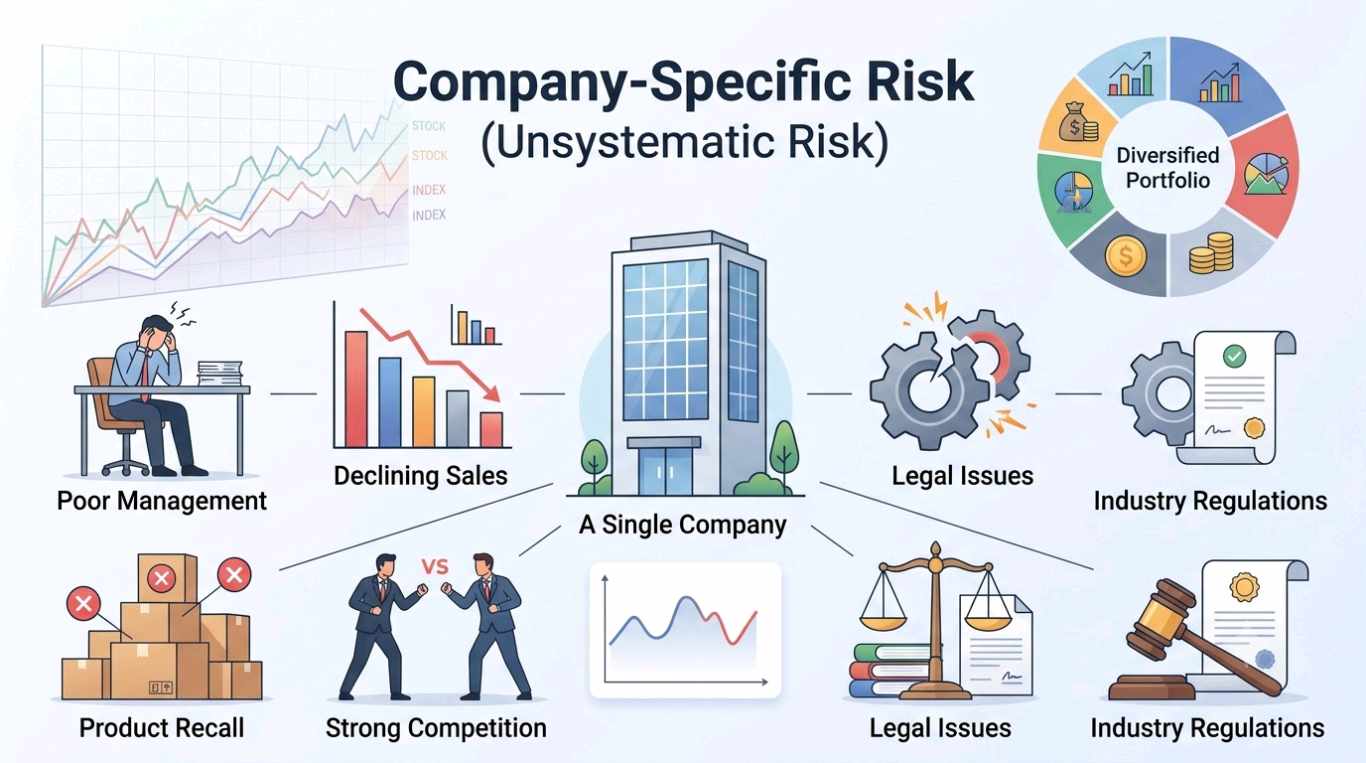
Company-specific risk, also known as unsystematic risk, is the possibility that an investment may lose value because of problems affecting a particular company, industry, or business sector. Unlike market-wide risk, this type of risk can often be reduced through diversification. Examples include poor management decisions, declining sales, product recalls, strong competition, lawsuits, operational problems, and industry-specific regulatory changes.
When people invest in stocks, bonds, mutual funds, or other financial assets, they face different types of investment risk. Some risks affect almost every investment in the market, while others are connected mainly to one company or a specific industry. Understanding this difference can help investors make more informed decisions.
This article explains company-specific risk in simple language, including its meaning, causes, examples, effects on investments, relationship with diversification, and practical ways investors can manage it.
What Is Company-Specific Risk?
Company-specific risk is the risk that an investment will perform poorly because of events or conditions directly related to a particular company. It is also called unsystematic risk, diversifiable risk, specific risk, or idiosyncratic risk.
For example, imagine an investor owns shares of a company that suddenly experiences a major product failure. Customers may lose confidence, sales may decline, and the company's stock price may fall. If other companies and the overall economy are performing normally, the problem is mainly connected to that particular business.
Simple Definition
Company-specific risk is the possibility of losing investment value because of problems unique to a particular company or industry.
Key Features of Unsystematic Risk
Company-specific risk has several characteristics that make it different from broader market risk.
- It is company or industry related: The risk is linked to a specific business or sector.
- It can often be reduced: Diversification can lower exposure to individual-company problems.
- It may arise suddenly: Events such as product recalls or management failures can happen unexpectedly.
- Its impact varies: Some events may have a small effect, while others can significantly affect revenue and investor confidence.
- It requires company research: Financial statements, management quality, competition, and business strategy can provide useful information about potential risks.
Major Causes of Company-Specific Risk
Many different events can create unsystematic risk. Some of the most common causes are described below.
1. Poor Management Decisions
Management plays an important role in the success of a company. Poor strategic decisions, ineffective leadership, excessive borrowing, weak cost control, or failed expansion plans can negatively affect business performance.
A company with strong products can still face difficulties if its management fails to respond to changing customer needs or competitive conditions.
2. Declining Sales
A sustained decline in sales can reduce revenue and profitability. Falling demand may occur because customers have changed their preferences, competitors have introduced better alternatives, or the company's products have become outdated.
Investors often monitor sales growth, revenue trends, profit margins, and earnings to understand whether a business is maintaining its financial strength.
3. Product Recalls or Quality Problems
A defective product can create financial and reputational problems. A company may need to recall products, compensate customers, pay additional costs, or deal with legal claims.
Even when the direct financial cost is manageable, damage to consumer trust can affect future sales.
4. Competitive Pressure
Strong competition can reduce a company's market share and pricing power. New competitors may introduce cheaper products, better technology, faster services, or more attractive customer experiences.
This is particularly important in industries where technology and consumer preferences change rapidly.
5. Regulatory Changes
Changes in laws or regulations can affect a particular company or industry. New compliance requirements, environmental standards, licensing rules, or industry restrictions may increase operating costs or change the way a company conducts business.
6. Operational Problems
Supply-chain disruptions, equipment failures, production problems, cybersecurity incidents, or inefficient internal processes can interrupt normal business operations.
7. Legal and Reputation Issues
Lawsuits, investigations, ethical controversies, or reputational problems can reduce customer confidence and potentially affect the value of a company.
Examples of Company-Specific Risk
Understanding examples makes the concept easier to remember.
| Risk Factor | Possible Effect on Company |
|---|---|
| Poor management | Weak strategy, higher costs, declining profitability |
| Product recall | Additional expenses and loss of customer confidence |
| Declining sales | Lower revenue and potentially lower profits |
| New competitor | Loss of market share and pricing pressure |
| Legal dispute | Financial costs and reputational damage |
| Industry regulation | Higher compliance costs or operational restrictions |
| Supply-chain issue | Production delays and increased expenses |
How Diversification Reduces Company-Specific Risk
One of the most important ways to manage unsystematic risk is diversification. Diversification means spreading investments across different companies, industries, assets, or other suitable categories instead of concentrating too much money in one investment.
Suppose an investor owns shares in only one company. If that company experiences a major business problem, the investor's entire stock investment may be affected.
However, if investments are spread across several unrelated companies and sectors, a problem affecting one business may have a smaller effect on the overall portfolio.
Important Principle
Do not put all your investment exposure into a single company or a single industry. Diversification can help reduce the impact of company-specific events.
Company-Specific Risk vs Systematic Risk
These two terms are often confused, but they describe different types of investment risk.
| Feature | Company-Specific Risk | Systematic Risk |
|---|---|---|
| Meaning | Risk related to a particular company or industry | Risk affecting a broad market or economy |
| Common name | Unsystematic risk | Market risk |
| Example | Product recall or management failure | Major economic slowdown |
| Diversification | Can often reduce the risk | Cannot completely eliminate it through diversification |
Why Company-Specific Risk Matters to Investors
Investors should understand company-specific risk because a financially attractive investment can still experience significant uncertainty.
Before investing, an investor may examine factors such as:
- Revenue and earnings trends
- Debt levels and interest obligations
- Cash flow and liquidity
- Management quality
- Competitive advantages
- Industry conditions
- Customer concentration
- Product and service quality
- Regulatory exposure
- Business reputation
This type of research does not remove investment risk, but it can help an investor understand the business more clearly.
Ways to Manage Company-Specific Risk
1. Diversify Your Portfolio
Holding exposure to different companies and industries can reduce dependence on the performance of one business.
2. Research Before Investing
Review a company's business model, financial performance, debt, management, competition, and major risks before making an investment decision.
3. Avoid Excessive Concentration
Concentrating too much of a portfolio in one company can make the portfolio highly sensitive to company-specific events.
4. Monitor Important Developments
Investors should pay attention to major business announcements, financial results, changes in management, regulatory developments, and industry trends.
5. Think About Long-Term Portfolio Risk
Instead of focusing only on short-term price movements, investors can consider how a company's fundamental business risks may affect its long-term prospects.
How to Identify Company-Specific Risk
There is no single formula that can identify every company-specific risk. However, investors can create a basic risk checklist.
- Is the company heavily dependent on one product?
- Does it depend on a small number of major customers?
- Is the business carrying a high level of debt?
- Are sales and profits becoming weaker?
- Is competition increasing?
- Could new regulations significantly affect the business?
- Has the company experienced repeated operational problems?
- Does the company have strong financial reserves?
These questions can help investors identify areas that deserve further research.
Does Diversification Completely Eliminate Risk?
No. Diversification can significantly reduce company-specific risk, but it cannot eliminate every type of investment risk.
For example, an economic crisis, broad market decline, major interest-rate changes, or widespread financial disruption may affect many investments at the same time. These are examples of broader market risks rather than risks unique to one company.
Therefore, diversification should be viewed as a risk-management strategy, not as a guarantee against losses.
Common Mistakes Investors Make
- Putting too much money into one company
- Ignoring company financial statements
- Following market hype without research
- Ignoring increasing competition
- Overlooking debt and cash-flow problems
- Assuming past performance guarantees future results
- Confusing company-specific risk with overall market risk
Explore More Business Topics
Want to read more articles related to business, finance, and practical money concepts?
5 Random Posts
Recommended Reads
Frequently Asked Questions
What is company-specific risk?
Company-specific risk is the possibility that an investment may lose value because of problems affecting a particular company or industry. It is also known as unsystematic or diversifiable risk.
What is another name for company-specific risk?
Common terms include unsystematic risk, specific risk, diversifiable risk, and idiosyncratic risk.
Can company-specific risk be reduced?
Yes. Diversification across different companies and industries can reduce exposure to risks associated with any single business.
What are examples of unsystematic risk?
Examples include poor management, product recalls, declining sales, lawsuits, operational failures, competitive pressure, and industry-specific regulatory changes.
Is systematic risk the same as company-specific risk?
No. Company-specific risk is connected mainly to a particular company or industry, while systematic risk affects a broad market or economy.
Does diversification guarantee that an investor will not lose money?
No. Diversification can reduce company-specific risk, but it cannot completely protect an investment portfolio from broad market or economic declines.
Conclusion
Company-specific risk is an important concept for anyone learning about investing and portfolio management. It arises from events that mainly affect a particular company or industry, such as poor management, declining sales, product problems, competition, lawsuits, operational difficulties, or regulatory changes.
The good news is that this type of risk is generally considered diversifiable risk. Spreading investments across different companies, industries, and suitable asset categories can reduce the effect that one company's problems have on the overall portfolio.
However, diversification does not eliminate all investment risk. Investors should combine diversification with sensible research, realistic expectations, and an understanding of both company-specific and broader market risks.