
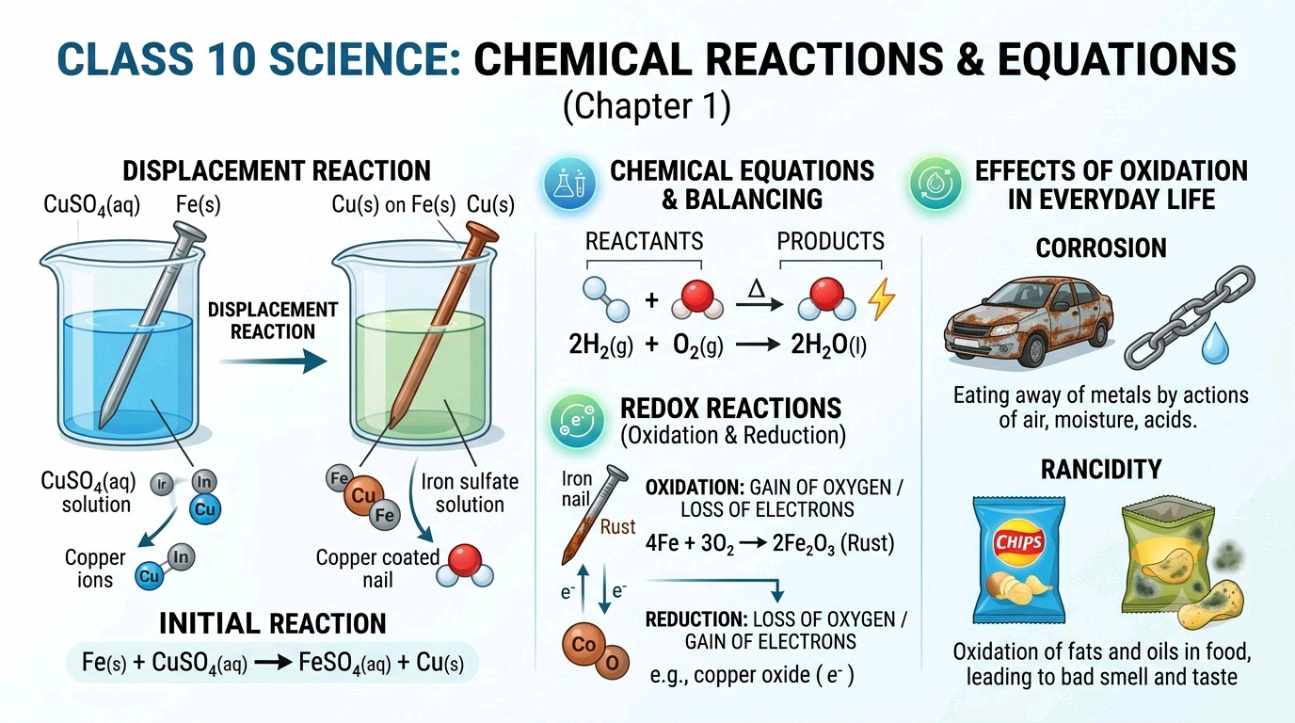
Chapter 1: Chemical Reactions and Equations
Complete Class 10 Science Notes with Important Questions, Chemical Equations, Reaction Types, Redox Reactions, Corrosion and Rancidity
Chemical reactions and equations are used to describe how one or more substances change into new substances. A chemical equation represents a reaction using chemical symbols and formulas. For an equation to be scientifically correct, it should be balanced, meaning that the number of atoms of every element remains the same on both sides. This chapter also covers important types of reactions such as combination, decomposition, displacement and double displacement, along with oxidation, reduction, redox reactions, exothermic reactions, endothermic reactions, corrosion and rancidity.
These concepts are important for understanding everyday chemical changes and for preparing answers to common Class 10 Science questions. The notes below explain each topic in simple language with examples and balanced equations.
1. What Is a Balanced Chemical Equation?
A balanced chemical equation is a chemical equation in which the number of atoms of every element is equal on both the reactant side and the product side.
For example, hydrogen reacts with oxygen to form water. The initially written equation is:
This equation is not balanced because there are two oxygen atoms on the left but only one oxygen atom on the right. We balance it by placing suitable coefficients before the chemical formulas:
Now there are four hydrogen atoms and two oxygen atoms on each side.
Why Should Chemical Equations Be Balanced?
Chemical equations should be balanced for several important reasons:
- They follow the law of conservation of mass.
- They show the correct ratio of reactants and products.
- They make chemical calculations more accurate.
- They provide a scientifically correct representation of a reaction.
- They help us understand how many particles or molecules participate in a reaction.
2. Types of Chemical Reactions
Chemical reactions can be grouped into different categories according to how reactants are converted into products. Four important types are combination, decomposition, displacement and double displacement reactions.
| Type | Meaning | Example |
|---|---|---|
| Combination | Two or more substances combine to form one product. | CaO + H₂O → Ca(OH)₂ |
| Decomposition | One compound breaks into two or more simpler substances. | CaCO₃ → CaO + CO₂ |
| Displacement | A more reactive element displaces a less reactive element. | Fe + CuSO₄ → FeSO₄ + Cu |
| Double Displacement | Two compounds exchange their ions to form new compounds. | Na₂SO₄ + BaCl₂ → BaSO₄ + 2NaCl |
Combination Reaction
A combination reaction occurs when two or more reactants combine to form a single product.
Here, calcium oxide combines with water to form calcium hydroxide. Since multiple reactants produce one main product, it is called a combination reaction.
Decomposition Reaction
A decomposition reaction is the opposite of a combination reaction. In this reaction, one compound breaks down into two or more simpler substances.
Calcium carbonate decomposes on heating to form calcium oxide and carbon dioxide.
Decomposition reactions can occur due to:
- Heat – thermal decomposition
- Light – photochemical decomposition
- Electricity – electrolytic decomposition
Displacement Reaction
In a displacement reaction, a more reactive element replaces a less reactive element from its compound.
Iron is more reactive than copper. Therefore, iron removes copper from copper sulfate and forms ferrous sulfate.
Double Displacement Reaction
A double displacement reaction occurs when two compounds exchange their ions and form two new compounds.
In this reaction, barium sulfate is formed as an insoluble white precipitate. Therefore, this reaction is also called a precipitation reaction.
📚 More Education Posts
Loading education posts...
3. Redox Reaction, Oxidation and Reduction
A redox reaction is a reaction in which oxidation and reduction take place simultaneously. The word redox is formed from reduction + oxidation.
Consider the following reaction:
In this reaction, copper oxide loses oxygen and changes into copper. Loss of oxygen is considered reduction.
At the same time, hydrogen gains oxygen and forms water. Gain of oxygen is considered oxidation.
• Oxidized substance: Hydrogen (H₂)
• Reduced substance: Copper oxide (CuO)
What Is Oxidation?
Oxidation can be understood as the gain of oxygen or loss of hydrogen. In terms of electrons, oxidation is associated with loss of electrons.
What Is Reduction?
Reduction can be understood as the loss of oxygen or gain of hydrogen. In terms of electrons, reduction is associated with gain of electrons.
Remember that oxidation and reduction generally occur together in a redox reaction.
4. Exothermic and Endothermic Reactions
Chemical reactions can either release energy into the surroundings or absorb energy from the surroundings. Based on this energy change, they are commonly classified as exothermic and endothermic reactions.
What Is an Exothermic Reaction?
An exothermic reaction is a chemical reaction that releases energy, usually in the form of heat or sometimes light.
Common examples include:
- Combustion of fuels
- Respiration
- Burning of substances
- Some reactions between acids and bases
Why Is Respiration an Exothermic Reaction?
Respiration is considered an exothermic process because energy is released when glucose reacts with oxygen. Living cells use this released energy to perform different biological activities.
The energy released during this reaction is useful to organisms for movement, growth, repair and other life processes.
What Is an Endothermic Reaction?
An endothermic reaction is a chemical reaction that absorbs energy from its surroundings.
For example, calcium carbonate requires heating to decompose:
Photosynthesis is also commonly described as an energy-absorbing process because plants use light energy to manufacture food.
| Feature | Exothermic Reaction | Endothermic Reaction |
|---|---|---|
| Energy | Energy is released. | Energy is absorbed. |
| Effect | Surroundings may become warmer. | Surroundings may become cooler as energy is absorbed. |
| Example | Respiration | Thermal decomposition |
5. Corrosion and Rancidity
What Is Corrosion?
Corrosion is the gradual deterioration of a metal because of chemical reactions with substances in its environment. Oxygen, moisture and other environmental factors can contribute to corrosion.
The formation of rust on iron is one of the most familiar examples of corrosion. Rusting requires suitable contact with oxygen and moisture.
Corrosion can weaken metal objects and cause economic loss. It can affect tools, machines, bridges, vehicles and other metal structures.
How Can Corrosion Be Prevented?
- Painting: A paint layer prevents direct contact with air and moisture.
- Oiling and greasing: These create a protective barrier.
- Galvanisation: Iron or steel is coated with zinc to provide protection.
- Alloying: Combining metals with other elements can improve corrosion resistance.
- Keeping metal surfaces dry: Reducing moisture can slow corrosion.
What Is Rancidity?
Rancidity refers to the deterioration of fats and oils due mainly to oxidation. Food affected by rancidity can develop an unpleasant smell and taste.
Foods containing fats and oils are more likely to become rancid when they are exposed to oxygen for extended periods, especially under unsuitable storage conditions.
How Can Rancidity Be Prevented?
- Store food in airtight containers.
- Reduce unnecessary exposure to oxygen.
- Protect suitable food products from excessive heat and light.
- Use permitted antioxidants where appropriate.
- Some packaged foods use nitrogen gas to reduce oxygen exposure.
Why Does Copper Sulfate Solution Change Colour When an Iron Nail Is Dipped in It?
When a clean iron nail is dipped into a copper sulfate (CuSO₄) solution, a displacement reaction takes place.
Iron is more reactive than copper. Therefore, iron displaces copper from copper sulfate.
Copper sulfate solution is blue, while ferrous sulfate solution has a pale green colour. As ferrous sulfate forms, the original blue colour changes. At the same time, copper may deposit on the surface of the iron nail as a reddish-brown layer.
Heating of Ferrous Sulfate Crystals
Ferrous sulfate crystals are commonly represented by the formula FeSO₄·7H₂O. When heated, they first lose their water of crystallisation. On stronger heating, ferrous sulfate decomposes.
The decomposition of ferrous sulfate can be represented by the following balanced equation:
The products are ferric oxide (Fe₂O₃), sulfur dioxide (SO₂) and sulfur trioxide (SO₃).
This is an example of a thermal decomposition reaction because heat causes the compound to break down into simpler substances.
Important Chemical Equations for Quick Revision
| Concept | Balanced Equation |
|---|---|
| Combination | CaO + H₂O → Ca(OH)₂ |
| Decomposition | CaCO₃ → CaO + CO₂ |
| Displacement | Fe + CuSO₄ → FeSO₄ + Cu |
| Double Displacement | Na₂SO₄ + BaCl₂ → BaSO₄ + 2NaCl |
| Redox Reaction | CuO + H₂ → Cu + H₂O |
| Respiration | C₆H₁₂O₆ + 6O₂ → 6CO₂ + 6H₂O + Energy |
| Ferrous Sulfate Heating | 2FeSO₄ → Fe₂O₃ + SO₂ + SO₃ |
Chapter 1 Quick Revision
- Balanced chemical equation: Equal atoms of every element on both sides.
- Combination reaction: Two or more reactants form one product.
- Decomposition reaction: One compound breaks into simpler substances.
- Displacement reaction: A more reactive element replaces a less reactive element.
- Double displacement reaction: Two compounds exchange ions.
- Oxidation: Gain of oxygen or loss of hydrogen.
- Reduction: Loss of oxygen or gain of hydrogen.
- Redox reaction: Oxidation and reduction occur together.
- Exothermic reaction: Releases energy.
- Endothermic reaction: Absorbs energy.
- Corrosion: Gradual deterioration of metals.
- Rancidity: Oxidation-related deterioration of fats and oils.
Frequently Asked Questions
What is a balanced chemical equation?
A balanced chemical equation has an equal number of atoms of every element on both the reactant and product sides.
Why should chemical equations be balanced?
Chemical equations are balanced to follow the law of conservation of mass. The total number of atoms of each element remains unchanged during a chemical reaction.
What is a combination reaction?
A combination reaction is one in which two or more substances combine to form a single product.
What is a decomposition reaction?
A decomposition reaction occurs when one compound breaks down into two or more simpler substances.
What is a displacement reaction?
It is a reaction in which a more reactive element displaces a less reactive element from its compound.
What is a double displacement reaction?
It is a reaction in which two compounds exchange ions and form two new compounds.
Why does copper sulfate solution change colour when an iron nail is dipped into it?
Iron is more reactive than copper and displaces copper from copper sulfate. Ferrous sulfate is formed, causing the solution's colour to change, while copper can deposit on the nail.
What is a redox reaction?
A redox reaction is a reaction in which oxidation and reduction occur simultaneously.
Which substance is oxidized in CuO + H₂ → Cu + H₂O?
Hydrogen is oxidized because it gains oxygen and forms water.
Which substance is reduced in CuO + H₂ → Cu + H₂O?
Copper oxide is reduced because it loses oxygen and forms copper.
What is an exothermic reaction?
An exothermic reaction releases energy, usually as heat, into the surroundings. Respiration is an important example.
What is an endothermic reaction?
An endothermic reaction absorbs energy from its surroundings. Thermal decomposition is one example.
Why is respiration considered an exothermic reaction?
Respiration releases energy when glucose reacts with oxygen. The released energy is used by living organisms for various activities.
What is corrosion?
Corrosion is the gradual deterioration of a metal due to chemical reactions with substances in its environment.
What is rancidity?
Rancidity is the oxidation-related deterioration of fats and oils, which can produce an unpleasant smell and taste.
How can rancidity be prevented?
Rancidity can be reduced by limiting oxygen exposure, using airtight packaging, storing suitable foods properly and using permitted antioxidants.
Write the equation for heating ferrous sulfate.
The strong-heating decomposition of ferrous sulfate is represented as: 2FeSO₄ → Fe₂O₃ + SO₂ + SO₃.
Conclusion
Chapter 1: Chemical Reactions and Equations provides the basic foundation for understanding chemical changes. The most important areas to remember are balancing chemical equations, identifying reaction types, understanding oxidation and reduction, recognising redox reactions, distinguishing exothermic and endothermic reactions, and explaining corrosion and rancidity.
For exam preparation, do not only memorise the definitions. Try to understand why each reaction occurs and practise writing the equations correctly. The examples of the iron nail and copper sulfate solution, respiration, decomposition reactions and ferrous sulfate heating are especially useful for revision.
A clear understanding of these concepts will make later chapters of chemistry easier to study because many chemical reactions involve the same basic ideas of reactants, products, conservation of atoms, oxidation, reduction and energy changes.