
How to Stay Safe in a Hostel: A Smart Guide to Privacy, Theft & Personal Safety
Hostels can be affordable, social and convenient, but sharing rooms and common facilities with other travelers means you should pay attention to your personal safety and privacy.
This guide explains what to check before booking, immediately after checking in and throughout your stay—without making your trip unnecessarily stressful.
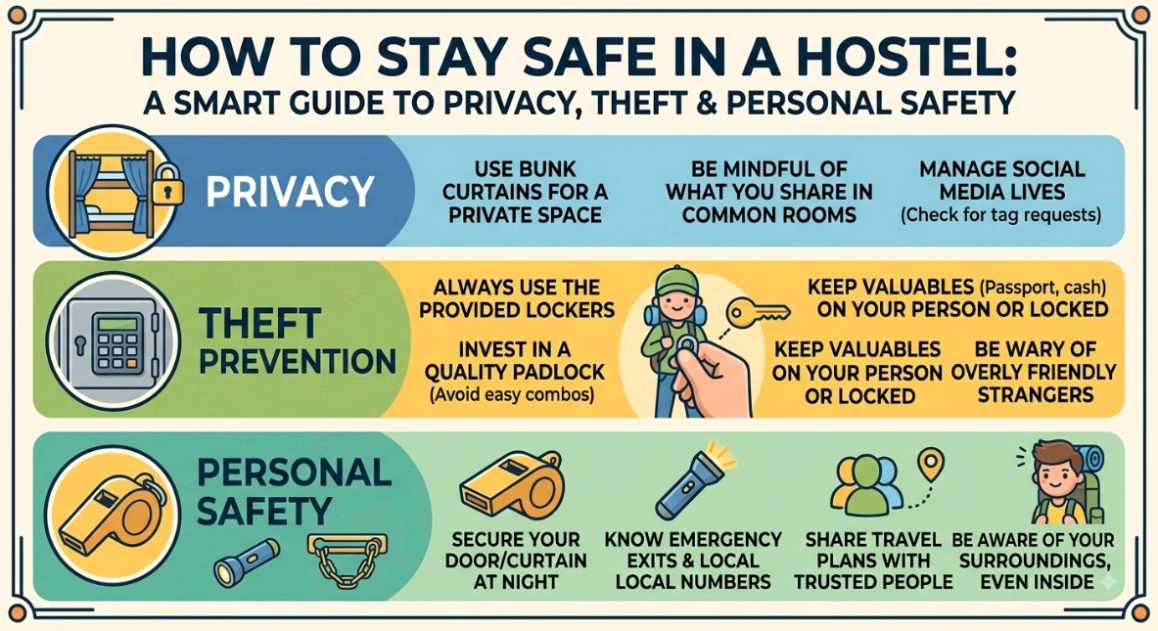
🌍 Why Hostel Safety Deserves Attention
Hostels are different from conventional hotels because guests may share dormitories, bathrooms, kitchens and other common areas. That social environment can be enjoyable, but it also means that personal belongings, privacy and boundaries need extra attention.
Good hostel safety is not about being afraid of everyone. It is about making sensible decisions, securing important belongings and knowing what to do if something feels wrong.
🏨 1. Choose the Hostel Carefully Before Booking
Your safety plan should begin before you arrive. Research the property, its location and recent guest reviews instead of choosing accommodation based only on the lowest price.
Official lodging-safety guidance also recommends researching accommodation, checking the surrounding area and considering properties with appropriate security measures.
🔐 2. Protect Your Passport, Money & Electronics
Your passport, identification documents, phone, cards and other valuables should not be left unsecured in a shared dormitory.
Keep Secure
- Passport and important documents
- Bank cards and essential cash
- Phone and laptop
- Camera and other electronics
- Travel documents
Smart Habits
- Use the hostel's locker when available.
- Use a suitable personal lock.
- Keep backups of important documents.
- Don't leave valuables unattended.
- Keep important items organised.
🗄️ 3. Use the Locker Correctly
A locker is useful only when you actually use it consistently. Keep valuable items secured whenever you leave the dormitory or go to sleep.
If the hostel provides lockers, check that the locker closes and locks properly. If there is a problem, tell staff rather than leaving valuable belongings exposed.
👥 4. Be Friendly With Roommates—but Keep Boundaries
Meeting people is one of the best parts of hostel travel. However, being friendly does not mean you have to share private information.
Information you don't need to share
- Your exact amount of cash
- Detailed travel plans
- Copies of important documents
- Banking information
- Passwords or account details
- Private information about your family
If another guest makes you uncomfortable, you don't need to confront them alone. Move to a public area and speak with hostel staff.
👀 5. Protect Your Privacy in Shared Rooms
Shared accommodation means other guests may enter and leave the room. Use practical privacy habits rather than assuming the room is completely private.
- Keep personal documents out of sight.
- Lock your phone and laptop when not in use.
- Avoid discussing sensitive information in crowded common areas.
- Use headphones when appropriate for private audio.
- Keep personal belongings organised and secured.
🔎 6. What About Hidden Cameras?
Privacy concerns are understandable, but it is important not to assume that every unusual object is a camera. Mobile apps cannot be treated as guaranteed hidden-camera detectors.
Instead, perform a normal visual inspection when you arrive. Pay attention to unusual or unexplained electronics, objects that appear out of place, or equipment that does not seem consistent with the room.
If you find something genuinely suspicious, do not tamper with it. Move to a safer/public area and report the concern to hostel management or the appropriate local authority.
Official lodging guidance similarly recommends checking the room for unusual electronics and reporting concerns to the front desk.
🚪 7. Check Doors, Windows & Emergency Exits
One of the first things you should do after checking in is understand how to leave the building in an emergency.
Knowing your emergency route before something happens is much easier than trying to understand the building during an emergency.
📱 8. Keep Your Phone Ready for Emergencies
Your phone can be an important safety tool while travelling. Keep it charged and make sure you know how to contact the hostel, a trusted person and local emergency services.
- Keep your phone sufficiently charged.
- Save the hostel's contact details.
- Keep important travel documents backed up securely.
- Know the local emergency number.
- Keep offline maps available when possible.
- Tell someone you trust where you are staying.
Travel-safety guidance also recommends keeping communication available, sharing itinerary information with someone trusted and having offline navigation available when possible.
🎒 9. Don't Carry Every Valuable Item Everywhere
Carrying unnecessary valuables increases the consequences if your bag is lost or stolen. Take only what you need for the activity and keep important documents appropriately secured.
Before leaving the hostel, quickly check: phone, wallet, keys, identification, essential documents and any medication you need.
🚕 10. Think About Safety Outside the Hostel Too
A safe hostel does not automatically make every journey outside it safe. Research transportation options and use reputable services.
If you use a ride service, check the vehicle and driver information before entering. Avoid accepting unexpected transportation offers from strangers.
For international travel, it is also sensible to review current destination guidance, local laws and transportation advice before departure.
🚨 11. What to Do If Something Feels Wrong
You don't need to wait until something becomes serious before asking for help. If a situation makes you uncomfortable, move toward a public area and contact hostel staff or someone you trust.
Move to a safer/public place → contact hostel staff → contact a trusted person → contact local emergency services when necessary.
If there is an immediate emergency, prioritize getting to a safe location and contacting the appropriate local emergency service.
🧳 12. A Simple Hostel Safety Checklist
❓ Frequently Asked Questions
Many hostels can be suitable for travelers, but safety can vary by property and location. Check recent reviews, choose a reputable hostel and follow basic safety practices during your stay.
Yes. If the hostel provides a secure locker, use it for valuables such as your passport, electronics, important documents and other items you do not want to leave exposed.
You can be friendly and social without sharing sensitive information such as detailed travel plans, financial information, passwords or private family details.
Check that the room door and windows are secure, locate the nearest emergency exit, understand the hostel's emergency arrangements and save the contact details of the property.
Move to a safe or public area and report the concern to hostel staff. If there is an immediate emergency, contact the appropriate local emergency service.
No app should be considered a guaranteed hidden-camera detection method. A sensible visual inspection and reporting genuinely suspicious equipment to hostel management is a better approach.
Keep your devices locked with a strong screen lock, avoid leaving them unattended in shared areas and use a secure locker whenever appropriate.
🏁 Final Thoughts
Staying in a hostel does not have to mean sacrificing safety or privacy. The most effective approach is simple: choose accommodation carefully, secure your belongings, maintain reasonable personal boundaries and know your emergency plan.
You don't need to be suspicious of every person you meet. Instead, stay aware, trust your judgment and ask hostel staff for help when something genuinely concerns you.
Smart travel is not about fear—it is about preparation.