
What Is Web 4.0? Understanding the Future of the Internet
The internet has changed dramatically over time. The early web mainly allowed people to read information. Web 2.0 made the internet interactive and social, allowing users to create and share content. Web 3.0 introduced ideas such as decentralization, data ownership, blockchain and machine-readable information.
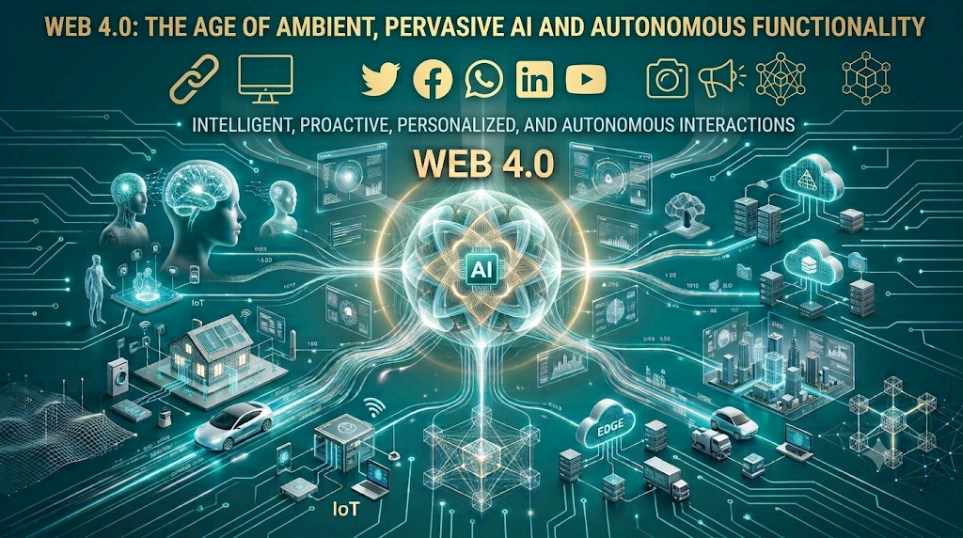
Web 4.0 takes this evolution further by imagining a highly intelligent, connected and responsive web. It is often associated with artificial intelligence, Internet of Things (IoT), extended reality (XR), edge computing, blockchain, autonomous AI agents and seamless communication between the digital and physical worlds.
It is important to understand that Web 4.0 is still an evolving concept rather than a single finished technology or universally agreed standard. Different researchers and organizations describe it in slightly different ways. However, a common theme is the movement toward a web that can understand context, connect devices, automate tasks and support richer human-machine interaction.
Main Topics
How Did the Web Evolve From Web 1.0 to Web 4.0?
Understanding Web 4.0 becomes easier when we look at the major stages of internet development.
Web 1.0 – The Read-Only Web
Web 1.0 was primarily a collection of static websites. Users visited pages to read information, but interaction was limited.
- Mostly static web pages
- Limited user interaction
- Information was mainly one-way
- Websites functioned like digital information pages
In simple terms, Web 1.0 was mainly about reading.
Web 2.0 – The Social and Interactive Web
Web 2.0 introduced a much more interactive internet. Social networks, blogs, video platforms, online communities and collaborative websites allowed users to create and share information.
- User-generated content
- Social media
- Online collaboration
- Interactive web applications
- Cloud-based services
The major idea behind Web 2.0 was participation. Users were no longer just readers; they became content creators and active participants.
Web 3.0 – The Decentralized and Intelligent Web
Web 3.0 is commonly associated with decentralization, blockchain, digital ownership, semantic technologies, artificial intelligence and greater control over data. However, the exact meaning of Web 3.0 also varies depending on the context.
Blockchain and decentralized technologies can reduce dependence on centralized intermediaries, while AI can help applications understand and process information more intelligently. Research on Web 3.0 also highlights the role of blockchain, AI and edge computing.
Web 4.0 – The Symbiotic and Connected Web
Web 4.0 is often described as a more intelligent and symbiotic web where humans and technology interact continuously. Instead of simply responding to commands, future systems may understand context, coordinate with other systems and perform tasks with greater autonomy.
Key Features of Web 4.0
1. Advanced Artificial Intelligence
AI is expected to be one of the most important technologies behind Web 4.0. Future web applications could use AI not only to generate answers but also to understand context, make recommendations, coordinate tasks and interact with other software systems.
AI agents could potentially perform multi-step activities instead of requiring users to manually complete every step. Recent research on Web 4.0 specifically discusses autonomous AI agents, decentralized coordination and human-AI collaboration.
2. Intelligent AI Agents
A traditional chatbot generally waits for a user request. An AI agent can be designed to pursue a goal by planning actions, using tools and interacting with other systems.
In a Web 4.0 environment, AI agents could potentially communicate with other agents, applications and connected devices. This could create machine-to-machine and agent-to-agent interaction.
- Task automation
- Decision support
- Multi-agent communication
- Personalized digital assistance
- Automated workflows
3. Internet of Things (IoT)
IoT connects physical objects to digital networks. Smart watches, sensors, vehicles, home appliances, industrial machines and other devices can collect and exchange data.
Web 4.0 could make these connected devices more intelligent by combining IoT data with AI. Instead of devices simply sending information, they could potentially analyze situations and respond automatically.
4. Human-Machine Collaboration
One of the central ideas of Web 4.0 is a closer relationship between humans and machines. Interfaces may become more natural through voice, vision, gestures, immersive environments and intelligent assistants.
The goal is not necessarily to replace people. Instead, technology can assist people by handling repetitive tasks and providing useful information at the right time.
5. Real-Time Personalization
Web 4.0 could provide experiences that adapt to a user's context. Instead of showing exactly the same experience to everyone, intelligent systems may consider factors such as preferences, location context, device information, previous interactions and current activity.
This could lead to context-aware computing where digital services respond more naturally to what a person is trying to accomplish.
6. Extended Reality (XR)
Virtual Reality (VR), Augmented Reality (AR) and Mixed Reality (MR) can create more immersive digital experiences.
Web 4.0 could connect these immersive environments with AI, IoT and real-world data. This may support virtual collaboration, digital twins, interactive education, industrial training and new forms of entertainment.
7. Blockchain and Digital Trust
Blockchain can provide a distributed record of transactions and interactions. In Web 4.0 discussions, distributed ledger technology can support areas such as digital identity, verification, transactions and decentralized coordination.
However, blockchain is not automatically required for every Web 4.0 application. The technology should be used where decentralization, verifiability or shared trust provides a practical benefit.
8. Edge Computing
Traditional cloud systems often process data in centralized data centers. Edge computing moves some processing closer to the device or user.
This can be particularly useful when applications need low latency, such as autonomous systems, industrial IoT, smart infrastructure and real-time immersive experiences.
The combination of IoT, AI and edge computing is increasingly important for systems that need real-time processing and distributed intelligence.
9. Interoperability
Another important Web 4.0 idea is interoperability. Different applications, devices, platforms and networks should ideally be able to communicate instead of operating as isolated systems.
For example, a smart vehicle could potentially communicate with charging infrastructure, traffic systems, navigation services and other connected systems through compatible protocols.
10. Physical and Digital World Integration
Web 4.0 increasingly focuses on connecting the digital and physical worlds. Sensors can observe physical environments, AI can interpret the collected data, and connected systems can respond.
This creates a more continuous relationship between people, software, machines and physical environments. The integration of AI, IoT, XR and distributed technologies is a recurring theme in contemporary Web 4.0 research.
Technologies That Could Power Web 4.0
| Technology | Possible Role in Web 4.0 |
|---|---|
| Artificial Intelligence | Intelligent decisions, personalization and automation |
| AI Agents | Autonomous task execution and system coordination |
| Internet of Things | Connecting physical devices and sensors |
| Blockchain | Decentralized trust, identity and verifiable transactions |
| Edge Computing | Low-latency local processing |
| XR | Immersive digital experiences |
| Cloud Computing | Scalable data storage and processing |
| Digital Twins | Digital representations of physical objects or systems |
| Advanced Networks | Fast communication between connected systems |
| Quantum Computing | Potential future support for specialized computational problems |
Important: Not every Web 4.0 system will necessarily use all these technologies. Web 4.0 is better understood as a broad technological direction rather than a single software package.
How Web 4.0 Could Change Everyday Life
Smart Homes
A future smart home could combine AI, sensors and connected appliances. Instead of manually controlling every device, an intelligent system could coordinate lighting, temperature, security and energy usage based on context.
Healthcare
Connected wearable devices could continuously collect relevant health-related signals. AI systems could analyze patterns and help professionals identify potential issues earlier. Such systems would still require strong privacy, security, safety and regulatory controls.
Education
Web 4.0 could enable adaptive learning, AI tutoring, virtual laboratories and immersive educational environments. Learning systems may adjust explanations and exercises according to a student's progress.
Business and Work
AI agents could automate repetitive administrative tasks, summarize information, coordinate workflows and help teams make decisions. Human workers could focus more on creativity, strategy and complex problem-solving.
Smart Cities
Connected traffic systems, environmental sensors, energy networks and public infrastructure could exchange information in real time. AI could analyze this data to improve resource management and operational efficiency.
Transportation
Connected vehicles and intelligent transportation systems could communicate with infrastructure and other services. This may support better traffic management, route optimization and autonomous mobility.
Retail and E-Commerce
AI-powered systems could provide highly personalized shopping experiences. Instead of simply recommending products based on previous purchases, future systems may understand broader context and help users complete complex shopping tasks.
Entertainment
AI, XR and real-time personalization could create interactive entertainment experiences where digital environments respond dynamically to users.
Web 4.0 vs Web 1.0, Web 2.0 and Web 3.0
| Web Generation | Main Idea | User Experience |
|---|---|---|
| Web 1.0 | Information | Mostly read |
| Web 2.0 | Interaction and social content | Read, create and share |
| Web 3.0 | Decentralization and intelligent data | Greater ownership and machine-readable information |
| Web 4.0 | Intelligent, connected and adaptive ecosystems | Humans, AI and machines cooperate |
This comparison is a simplified model. The boundaries between Web 3.0 and Web 4.0 are not universally defined, and many technologies overlap between these concepts.
What Are the Benefits of Web 4.0?
- More automation: Intelligent systems could perform repetitive tasks automatically.
- Better personalization: Digital services could adapt to individual context.
- Faster responses: Edge computing can support applications requiring low latency.
- Connected devices: IoT can bring physical devices into intelligent digital ecosystems.
- Immersive experiences: XR can make digital interaction more natural and engaging.
- Better collaboration: Humans and AI systems could work together on complex tasks.
- Potentially greater transparency: Distributed technologies can provide verifiable records where appropriate.
What Are the Challenges of Web 4.0?
Privacy and Data Protection
A highly connected internet could generate enormous amounts of personal and environmental data. Protecting this information will be one of the biggest challenges.
AI Bias and Accountability
If AI systems make increasingly important decisions, users need to understand who is responsible when something goes wrong. Transparency, explainability and accountability will become increasingly important.
Cybersecurity
Connecting more devices also creates more potential attack surfaces. Smart homes, vehicles, industrial systems and AI agents could become targets for cyberattacks.
Digital Inequality
Advanced technologies may not be equally available to everyone. Hardware costs, connectivity, digital skills and infrastructure can influence who benefits from the next generation of the web.
Interoperability Problems
If different platforms use incompatible standards, devices and AI systems may struggle to communicate. Open standards and reliable protocols will therefore be important.
Energy and Computing Requirements
Large AI models, decentralized networks and connected infrastructure can require significant computing resources. Efficient hardware, energy-aware software and sustainable infrastructure will be important for long-term growth.
Human Control
As systems become more autonomous, users need meaningful control. Automation should not mean that people lose the ability to understand, review or override important decisions.
Recent research also emphasizes privacy, governance, AI training, multi-agent interaction, scalability and regulatory alignment as important issues for future Web 4.0 systems.
What Will the Future of Web 4.0 Look Like?
The future of Web 4.0 is difficult to predict because the concept itself is still developing. However, several trends are already becoming visible.
- More capable AI assistants and agents
- Greater integration between AI and IoT
- More immersive AR and VR experiences
- Growth of edge and distributed computing
- More autonomous software workflows
- Improved machine-to-machine communication
- Closer integration between physical and digital environments
- Greater focus on digital identity, privacy and trust
Some researchers describe Web 4.0 as a future environment in which AI agents can interact with decentralized infrastructure and coordinate actions across digital and physical environments.
Is Web 4.0 Already Here?
Not as a complete, universally adopted version of the internet. Web 4.0 is still an emerging concept. However, many of its building blocks already exist.
AI assistants, autonomous software, IoT devices, cloud and edge computing, blockchain networks, digital twins, AR/VR systems and intelligent automation are already being developed and used in different areas.
Therefore, it is more accurate to say that the technologies associated with Web 4.0 are developing today, while the complete Web 4.0 vision remains a work in progress.
Why Web 4.0 Matters for Internet Users
For ordinary users, Web 4.0 may eventually make technology feel less complicated. Instead of opening several applications and manually transferring information between them, users could describe a goal and allow intelligent systems to coordinate the required services.
For example, a person might ask an AI system to plan a trip. Instead of simply returning search results, a future agent could compare transportation options, check schedules, organize a personalized itinerary and coordinate related digital services—with the user's permission.
This is the broader idea behind an action-oriented and intelligent web: technology becomes a collaborator rather than merely a collection of websites and applications.
Web 4.0 and the Future of AI Agents
One of the most interesting developments connected with Web 4.0 is the rise of AI agents. Traditional web applications generally wait for instructions from users. Agent-based systems can potentially plan and execute multiple steps toward a goal.
In a mature Web 4.0 ecosystem, agents could interact with databases, applications, devices, payment systems and other agents through secure protocols. This could create new forms of automated digital commerce and machine-to-machine collaboration.
However, autonomous systems need strong safeguards. Permission controls, identity, security, auditability, human oversight and clear responsibility will be essential if AI agents are allowed to perform real-world actions.
Web 4.0: A Simple Example
Imagine a smart office:
- IoT sensors detect room conditions.
- AI analyzes temperature, occupancy and energy usage.
- An AI agent decides whether adjustments are needed.
- Edge devices process urgent information locally.
- Connected systems communicate with building infrastructure.
- The user receives a simple explanation rather than manually controlling every device.
This combination of AI + IoT + automation + edge computing + connected infrastructure illustrates the kind of intelligent ecosystem often associated with Web 4.0.
Frequently Asked Questions About Web 4.0
What is Web 4.0 in simple words?
Web 4.0 is an emerging vision of a highly intelligent and connected internet where AI, people, machines and digital services can interact more naturally and automatically.
Is Web 4.0 the same as Web 3.0?
No. Web 3.0 is commonly associated with decentralization, blockchain, data ownership and intelligent or semantic technologies. Web 4.0 generally emphasizes deeper AI integration, automation, interoperability, connected devices and interaction between the physical and digital worlds. The exact boundaries are still debated.
What technologies are used in Web 4.0?
Potential Web 4.0 technologies include artificial intelligence, AI agents, IoT, blockchain, edge computing, cloud computing, extended reality, digital twins, advanced networking and potentially quantum computing.
Is Web 4.0 available now?
There is no single finished Web 4.0 platform that represents the entire internet. Instead, many technologies associated with the Web 4.0 vision already exist and are developing independently.
Will Web 4.0 replace websites?
Not necessarily. Websites and web applications are likely to remain important. Web 4.0 may make them more intelligent, interconnected and capable of working with AI agents and connected devices.
Will Web 4.0 use artificial intelligence?
AI is expected to be one of the most important technologies associated with Web 4.0. It can support personalization, automation, natural-language interaction, prediction and autonomous agents.
How will Web 4.0 affect businesses?
Businesses could use Web 4.0 technologies for intelligent automation, customer personalization, connected products, predictive systems, AI agents, digital twins and real-time decision support.
What are the biggest risks of Web 4.0?
Major concerns include privacy, cybersecurity, AI bias, accountability, digital inequality, interoperability, excessive automation and the energy or computing requirements of large-scale intelligent systems.
What is the main goal of Web 4.0?
The broad goal is to create a more intelligent, connected and adaptive digital environment in which humans, AI systems, machines and physical devices can cooperate more seamlessly.
Conclusion
Web 4.0 represents an evolving vision for the next generation of the internet. It goes beyond traditional websites and social platforms by bringing together artificial intelligence, AI agents, IoT, edge computing, blockchain, extended reality and other emerging technologies.
The most important idea is not simply that the internet will become faster or more visually impressive. Instead, the web could become more intelligent, context-aware, automated and connected to the physical world.
At the same time, Web 4.0 should not be treated as a finished technology. Its definition is still evolving, and many of its proposed capabilities are being developed through separate technologies today. The future success of this vision will depend not only on technical innovation but also on privacy, cybersecurity, interoperability, responsible AI, human control and inclusive access.
In simple terms, Web 1.0 was mainly about reading, Web 2.0 about participating, Web 3.0 about decentralization and intelligent data, and Web 4.0 aims toward a web where humans, AI and connected machines can work together.