
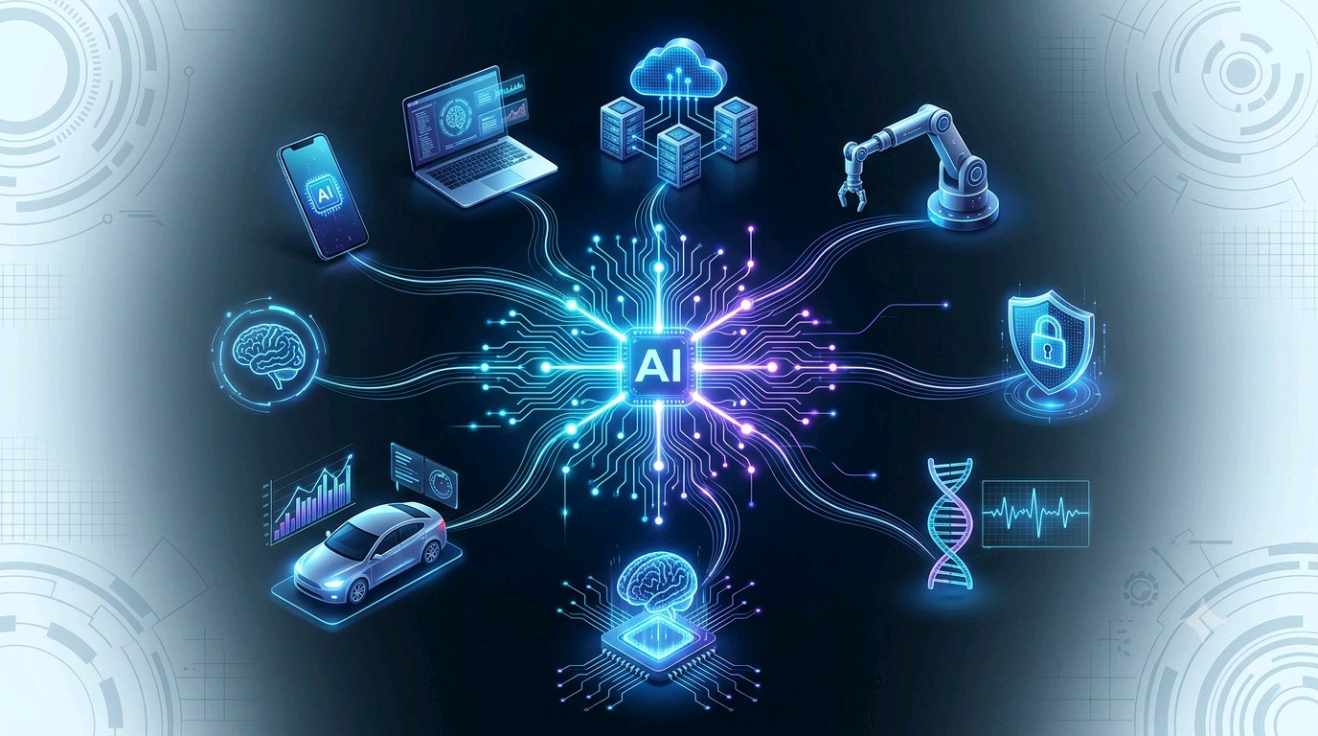
Artificial intelligence (AI) is revolutionizing technology by helping computers understand information, recognize patterns, generate content, automate tasks, and support human decision-making. From smartphones and search engines to healthcare, education, cybersecurity, software development, finance, transportation, and creative work, AI is becoming part of everyday digital life. The biggest change is that modern AI can do more than follow fixed instructions—it can learn from data and, with generative AI, create new text, images, audio, video, and code.
AI Revolutionizing Technology: What Does It Really Mean?
The phrase AI revolutionizing technology describes a major shift in how digital systems are designed and used. Traditional software generally depends on rules written by developers. AI systems can use data, statistical methods, machine learning models, and increasingly powerful computing to recognize patterns and produce useful outputs.
This does not mean that AI is a human brain. Modern AI systems are highly capable tools, but they can still make mistakes, misunderstand instructions, or produce inaccurate information. Responsible use therefore requires human judgment, verification, and appropriate security controls.
Why AI Has Become So Powerful
Several developments have pushed artificial intelligence forward:
- Large amounts of digital data provide training material for machine learning systems.
- More powerful computing hardware allows complex models to be trained and operated.
- Machine learning improvements have made pattern recognition much more effective.
- Deep learning has improved image, speech, language, and other complex tasks.
- Generative AI has made AI directly useful for writing, coding, designing, summarizing, and brainstorming.
- Cloud computing and APIs allow businesses and developers to add AI capabilities to existing applications.
Modern AI therefore represents not one single invention but the combination of many technologies working together.
Main Topics
What Is Artificial Intelligence?
Artificial intelligence is a broad field of computer science focused on creating systems that can perform tasks associated with human intelligence. These tasks may include understanding language, recognizing objects, analyzing information, making predictions, recommending content, and supporting decisions.
AI is already present in many everyday services. When a phone recognizes a face, an email service identifies spam, a navigation application predicts traffic, or a streaming platform recommends content, AI or machine learning may be involved.
AI Is Bigger Than Chatbots
Many people associate AI only with chatbots, but the technology is much broader. AI can be used for:
- Speech recognition
- Image and video analysis
- Recommendation systems
- Fraud detection
- Cybersecurity monitoring
- Predictive maintenance
- Language translation
- Search and information retrieval
- Robotics
- Personalized learning
- Software development
AI vs Machine Learning: What Is the Difference?
Artificial intelligence is the broader concept, while machine learning is one of the major approaches used to build AI systems. Machine learning allows systems to learn patterns from data rather than requiring every possible rule to be manually programmed.
| Technology | Simple Meaning | Example |
|---|---|---|
| Artificial Intelligence | Broad field of intelligent computer systems | AI-powered assistant |
| Machine Learning | Systems learn patterns from data | Fraud detection |
| Deep Learning | Machine learning using multi-layer neural networks | Image recognition |
| Natural Language Processing | Technology for understanding and generating human language | Language translation |
| Generative AI | AI that creates new content | Text, images, audio or code generation |
Understanding these differences makes it easier to understand why AI is appearing in so many different industries.
How Generative AI Is Changing Technology
Generative AI is one of the most visible developments in the modern AI revolution. Instead of only classifying information or predicting an outcome, generative models can create new content based on a user's instructions.
For example, a user can provide a prompt and ask an AI system to create a product description, explain a technical subject, summarize a document, generate programming code, create an image concept, or help develop ideas.
What Can Generative AI Create?
- Text: Articles, summaries, emails, explanations and ideas.
- Images: Illustrations, concepts, graphics and creative designs.
- Audio: Speech, narration and other audio content.
- Video: AI-assisted visual content and video concepts.
- Code: Programming assistance, explanations and code generation.
Generative AI can increase productivity, but generated content should not automatically be considered correct. AI systems can produce inaccurate or misleading information, so important facts should be checked before publication or decision-making.
How AI Is Revolutionizing Different Industries
1. Healthcare and Medical Technology
AI is helping researchers and healthcare organizations analyze large datasets, identify patterns, support medical imaging workflows, and improve research processes. It can assist professionals, but it should not replace qualified medical judgment.
Potential applications include:
- Medical image analysis
- Drug discovery research
- Patient data analysis
- Early pattern detection
- Administrative automation
2. Education
AI is changing the way students and educators interact with learning materials. AI-powered tools can explain difficult subjects in simpler language, generate practice questions, summarize information, and provide personalized learning assistance.
However, students should use AI as a learning assistant rather than a replacement for understanding. Fact-checking and original thinking remain important.
3. Business and Productivity
Businesses can use AI to automate repetitive work and analyze information more efficiently. Customer support, document processing, marketing research, data analysis, and internal knowledge systems are examples of areas where AI can provide practical value.
4. Software Development
AI is increasingly becoming a programming assistant. Developers can use AI tools to explain code, identify possible bugs, create documentation, generate test ideas, convert code between languages, and speed up routine development tasks.
Generated code still requires testing and security review. Developers should not blindly copy AI-generated code into production systems.
5. Cybersecurity
Cybersecurity generates huge amounts of information, including login events, network activity, alerts, and system logs. AI and machine learning can help identify unusual patterns and prioritize potentially important security events.
At the same time, attackers can also use AI to create more convincing scams or automate malicious activities. This makes AI security and responsible AI usage increasingly important.
6. Finance and Banking
AI can help financial organizations analyze transactions, detect suspicious activity, automate customer support, assess patterns, and improve operational efficiency.
Because financial decisions can have serious consequences, AI-based systems require strong controls, transparency, security, and human oversight.
7. Transportation and Smart Mobility
AI can analyze traffic patterns, optimize routes, assist driver-safety systems, and support logistics operations. Combined with sensors and connected devices, AI can help transportation systems respond to changing conditions more efficiently.
8. Marketing and Content Creation
AI is transforming digital marketing by helping businesses research audiences, generate ideas, personalize communication, analyze campaign data, and create content drafts.
The strongest results usually come from combining AI speed with human creativity, experience, editing, and brand knowledge.
Everyday Examples of AI You May Already Use
You may be using AI without consciously thinking about it. Common examples include:
- Voice assistants
- Smartphone face recognition
- Spam filtering
- Search suggestions
- Personalized recommendations
- Automatic photo enhancement
- Translation tools
- Navigation and traffic prediction
- AI writing assistants
- Customer-service chatbots
This is one reason the AI revolution is different from a technology trend that exists only inside laboratories. AI is increasingly embedded in ordinary digital products and services.
Benefits of AI in Modern Technology
When implemented responsibly, AI can provide several practical benefits.
- Automation: Repetitive tasks can be handled faster.
- Productivity: People can spend more time on higher-value work.
- Personalization: Services can adapt to individual users.
- Data analysis: Large datasets can be analyzed more efficiently.
- Accessibility: Speech, translation and assistive technologies can help more people use digital services.
- Innovation: AI can help researchers, developers and creators explore ideas faster.
- Decision support: AI can identify patterns that may be difficult to find manually.
Challenges and Risks of Artificial Intelligence
The AI revolution also creates important challenges. A responsible discussion about AI should include both its benefits and its limitations.
AI Can Make Mistakes
Generative AI can produce confident-sounding but incorrect answers. This is sometimes called an AI hallucination. Important information should therefore be verified using trustworthy sources.
Privacy and Data Security
Users should be careful about entering confidential information into AI services. Businesses also need clear rules for handling customer, employee, financial, and proprietary data.
Bias and Fairness
AI systems learn patterns from data. If training data or system design contains unwanted bias, the resulting system can produce unfair outcomes. Testing and responsible governance are therefore important.
Jobs and Changing Skills
AI may automate some tasks while creating demand for new skills and roles. Instead of thinking only in terms of jobs disappearing, it is useful to consider how individual tasks and workflows are changing.
Copyright and Ownership
AI-generated and AI-assisted content can raise questions about copyright, licensing, attribution, and ownership. Creators and businesses should understand the rules that apply to the tools and content they use.
How to Use AI More Effectively
Getting better results from AI is not simply about choosing the most powerful tool. The quality of the instructions, context, verification, and human review also matters.
1. Give Clear Instructions
Instead of asking a vague question, explain the goal, audience, format, and limitations. Specific prompts generally make AI responses more useful.
2. Provide Useful Context
If you want AI to help with a business task, explain the business goal and relevant background information. More useful context can lead to more relevant results.
3. Ask for Structured Output
You can request a table, checklist, step-by-step guide, comparison, summary, or other format depending on your needs.
4. Verify Important Information
AI should be treated as an assistant rather than an unquestionable authority. Check important technical, legal, medical, financial, and factual claims against reliable sources.
5. Keep Human Judgment in the Loop
The best AI workflows often combine machine speed with human judgment. AI can generate possibilities quickly, while humans provide context, ethics, experience, creativity, and final approval.
What Is the Future of AI?
The future of AI is likely to involve deeper integration into software, devices, business processes, search, robotics, education, scientific research, and creative tools.
One important direction is the development of AI agents and more capable AI workflows. Instead of simply answering one prompt, future systems may increasingly help coordinate multiple steps of a task, interact with software, retrieve information, and assist with longer workflows.
Multimodal AI is another important direction. These systems can work across combinations of text, images, audio, video, and other data types. This can make AI interfaces more natural and useful.
However, the future of AI will not depend only on technical capability. Trust, privacy, security, transparency, reliability, and responsible governance will also determine how successfully AI becomes part of society.
AI Skills That Can Be Valuable to Learn
You do not necessarily need to become an AI researcher to benefit from the AI revolution. Practical AI literacy can be useful across many careers.
- AI fundamentals
- Prompt writing
- Data analysis
- Critical thinking and fact-checking
- Automation workflows
- Basic programming
- AI-assisted content creation
- Cybersecurity awareness
- Responsible AI practices
- Understanding AI limitations
The most valuable combination may be domain expertise plus AI skills. A person who understands both their profession and how to use AI effectively can often apply the technology more intelligently than someone who only knows how to generate prompts.
AI and the Human Future
The most important question is not simply whether AI will become more powerful. The bigger question is how people choose to use that power.
AI can help people work faster, explore ideas, analyze information, and solve difficult problems. But human creativity, empathy, responsibility, judgment, and ethical decision-making remain essential.
Rather than viewing AI only as a replacement for human work, it can be more useful to think of it as a powerful technology that changes the way humans work. The people and organizations that learn how to combine AI with human expertise may be better positioned for the next stage of digital transformation.
Frequently Asked Questions About AI Revolutionizing Technology
What is AI revolutionizing technology?
It means artificial intelligence is changing how technology is developed and used by improving automation, prediction, personalization, content generation, data analysis, software development, and decision support.
How is AI different from traditional software?
Traditional software usually follows explicitly programmed rules, while many AI systems use learned patterns from data to make predictions, classifications, recommendations, or generate content.
Is generative AI the same as artificial intelligence?
No. Generative AI is a category within the broader AI field. It focuses on creating new content such as text, images, audio, video, and code.
Can AI replace human workers?
AI can automate certain tasks, but its impact varies by occupation. Many workflows are more likely to change through human-AI collaboration than through complete replacement.
Can AI make mistakes?
Yes. AI systems can produce incorrect, incomplete, biased, or misleading results. Important information should always be reviewed and verified.
How is AI used in everyday life?
AI can be found in search engines, recommendation systems, smartphones, navigation apps, spam filters, translation tools, voice assistants, photo applications, and customer-service systems.
What skills should beginners learn for AI?
Beginners can start with AI fundamentals, prompt writing, data literacy, critical thinking, fact-checking, automation, and basic understanding of machine learning and generative AI.
Is AI safe to use?
AI can be useful when used responsibly. Users should protect private information, verify important outputs, understand limitations, and follow the rules of the AI service they are using.
Conclusion
Artificial intelligence is no longer just a futuristic concept; it is becoming a practical part of modern technology. Machine learning helps systems identify patterns, while generative AI enables computers to create new content and assist with increasingly complex tasks. Together, these technologies are influencing software, education, healthcare, finance, cybersecurity, transportation, marketing, research, and everyday digital experiences.
The AI revolution brings enormous opportunities, but it also requires responsible use. AI can make mistakes, raise privacy concerns, introduce bias, and change existing workflows. The best approach is therefore not blind adoption or complete rejection. It is to learn how AI works, understand its limitations, verify important information, protect sensitive data, and combine AI capabilities with human judgment.
For individuals and businesses alike, learning how to work effectively with AI can become an important digital skill. The future of technology will likely belong not simply to AI, but to the people who know how to use AI intelligently, safely, and creatively.
Disclaimer
This article is provided for general educational and informational purposes. Artificial intelligence technologies change rapidly, and individual AI tools may have different capabilities, limitations, terms, privacy policies, and usage rules. Always verify important information through reliable sources and seek qualified professional advice where appropriate. Do not use AI-generated information as a substitute for professional medical, legal, financial, security, or other specialized advice.