
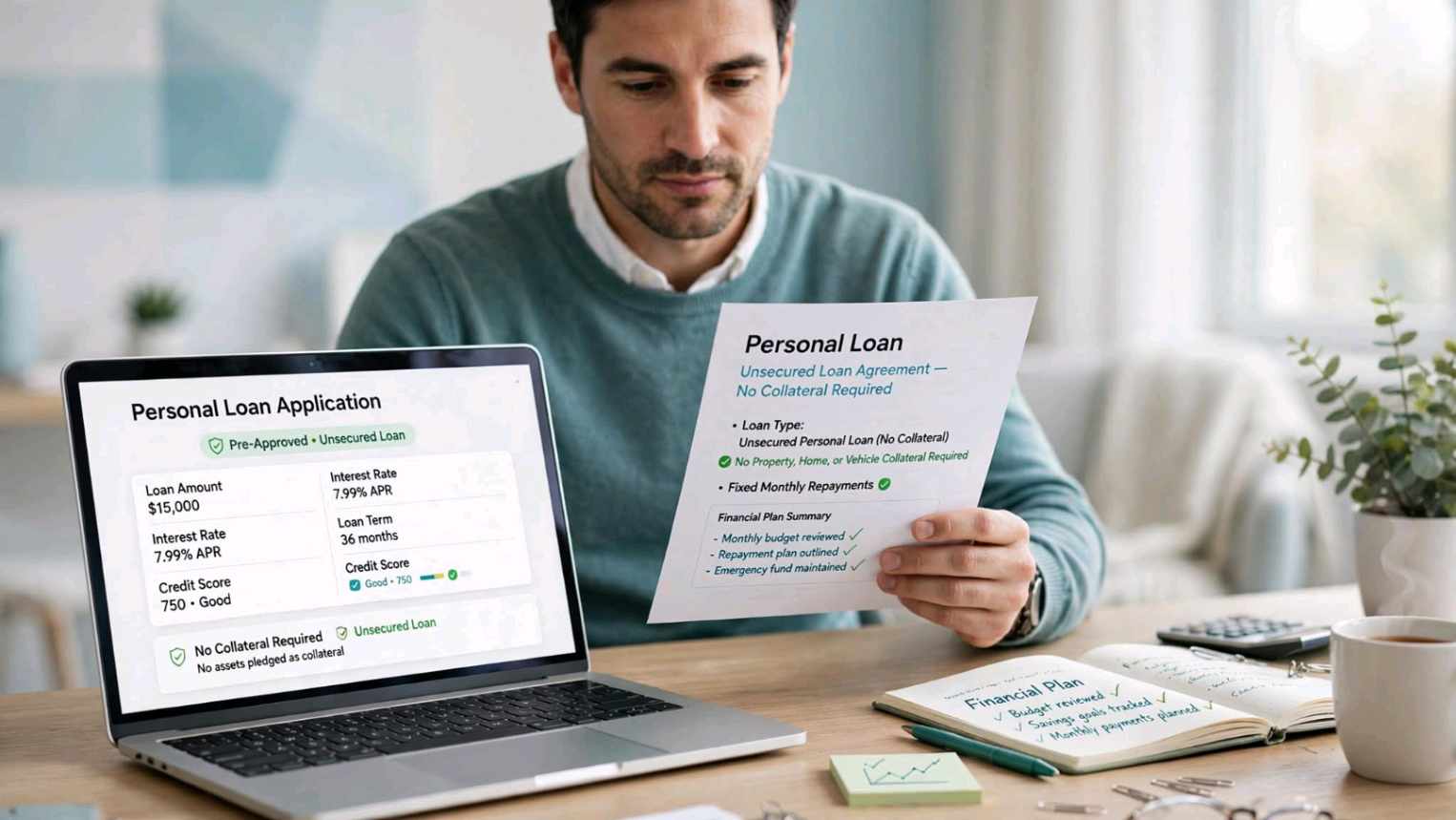
Need money for an emergency, major purchase, debt consolidation, education, home improvement, or another personal expense? An unsecured personal loan can allow you to borrow money without pledging your home, car, or another asset as collateral. Instead, lenders generally assess factors such as your credit history, income, existing debts, loan amount, repayment ability, and other information when deciding whether to approve the application and what terms to offer.
This guide explains how to get an unsecured personal loan without collateral, what lenders usually look for, which documents may be required, how to compare loan offers, what interest and fees mean, and how to avoid common borrowing mistakes.
How to Get an Unsecured Personal Loan Without Collateral
The basic process is straightforward: check your credit profile, decide how much you actually need, compare lenders, check eligibility, prepare your documents, submit an application, review the agreement carefully, and then accept the loan only if the repayment fits your budget.
Unlike a secured loan, an unsecured personal loan does not normally require you to pledge a specific asset as security. Because the lender is not relying on collateral, your creditworthiness and ability to repay can become especially important.
Main Topics
- What is an unsecured personal loan?
- How unsecured personal loans work
- Eligibility and credit requirements
- Documents you may need
- How to compare lenders and loan offers
What Is an Unsecured Personal Loan?
An unsecured personal loan is a loan that does not normally require you to provide an asset such as a house, vehicle, savings account, or other property as collateral. You receive the approved amount and repay it according to the agreement, usually through scheduled installments.
The lender takes greater repayment risk because there is no pledged asset supporting the loan. As a result, the lender may place more emphasis on your credit history, income, existing debt, employment or income stability, requested loan amount, and repayment capacity.
Personal installment loans commonly provide a lump sum at the beginning and require repayment through scheduled installments over an agreed period.
How Does an Unsecured Personal Loan Work?
The process usually begins when you submit an application. The lender reviews the information provided and may check your credit report, income, debts, and other financial information.
If approved, the lender provides an offer showing important terms such as the amount, interest rate, repayment period, fees, and payment schedule. You should review these terms before accepting the loan.
- Application: Provide your personal and financial information.
- Verification: The lender checks information such as identity, income, and credit history.
- Credit assessment: The lender evaluates your ability and likelihood to repay.
- Loan offer: If approved, you receive the applicable terms.
- Agreement: Review the complete loan contract before accepting.
- Disbursement: The approved money is provided according to the lender's process.
- Repayment: Make the scheduled payments until the loan is fully repaid.
Check Your Credit Score and Credit Report
Your credit score can influence whether you qualify for credit and the terms you receive. Lenders may use credit scores and credit reports as part of their assessment of repayment risk. A higher score can make it easier to qualify and may help you receive better borrowing terms, although requirements vary between lenders.
Your credit report can also contain errors. Before applying, review the information available to you and look for incorrect accounts, payment information, balances, or other mistakes.
Determine How Much You Really Need
One of the most important steps is deciding the loan amount. Do not automatically borrow the maximum amount offered by a lender.
Calculate how much money is actually required and then consider whether the resulting monthly payment fits comfortably into your regular budget.
- List the actual expense you need to cover.
- Subtract any savings or other funds you can reasonably use.
- Estimate the amount you need to borrow.
- Calculate the expected monthly payment.
- Consider the total amount you will repay.
- Leave enough room in your budget for normal living expenses and unexpected costs.
A loan should solve a financial need without creating an unaffordable repayment burden.
Compare Different Lenders
Do not assume that every personal loan has the same cost. Banks, credit unions, online lenders, and other financial institutions may have different eligibility requirements, rates, fees, loan amounts, and repayment periods.
Compare multiple offers where possible rather than accepting the first offer you see.
| Loan Feature | What to Check |
|---|---|
| Interest rate | Check whether the rate is fixed or variable and how it affects repayment. |
| APR or total borrowing cost | Look beyond the headline interest rate and check applicable fees and charges. |
| Loan term | Compare the repayment period and its effect on monthly payments and total cost. |
| Processing or origination fees | Check whether the lender charges an upfront or other loan-related fee. |
| Late-payment charges | Understand what happens if you miss or delay a payment. |
| Early repayment | Check whether additional charges or conditions apply when paying the loan early. |
The interest rate is the cost of borrowing, while an APR can incorporate the interest rate plus certain additional charges. Comparing the applicable total cost can therefore give you a clearer picture than comparing the advertised rate alone.
Check Unsecured Personal Loan Eligibility
There is no single worldwide eligibility rule for an unsecured personal loan. Every lender may establish its own criteria.
Common factors can include:
- Credit history and credit score
- Income and income stability
- Existing debts
- Debt-to-income or similar affordability measures
- Requested loan amount
- Repayment period
- Identity and residency information
- Other information required by the lender
A lender may consider income and existing debt when deciding whether to offer credit and what terms to provide.
Documents You May Need
Even though an unsecured loan does not require collateral, lenders can still ask for documents to verify your identity and financial situation.
Depending on the lender and country, documents may include:
- Government-issued identification
- Proof of address or residency
- Recent payslips or income statements
- Bank statements
- Tax or income documents
- Employment information
- Details of existing loans and debts
The exact documentation can differ significantly between lenders, so check the lender's requirements before submitting an application.
Apply for the Loan
After comparing your options, you can submit an application through the lender's permitted channel. Many lenders provide online applications, while others may use branches, telephone applications, or financial intermediaries.
Enter your information carefully. Incorrect income, employment, address, or identity details can create delays or affect the assessment.
Also remember that a formal credit application may involve a credit inquiry. Depending on the credit system and lender, such an inquiry can affect your credit profile.
Read the Loan Agreement Before Accepting
Approval does not mean you should immediately accept the loan. Read the complete agreement and understand the financial commitment.
Pay particular attention to:
- Loan amount
- Interest rate
- APR or equivalent total-cost measure
- Monthly or scheduled payment
- Loan term
- Processing and other fees
- Late-payment charges
- Early repayment conditions
- Default consequences
- Any optional products or services included in the agreement
Advantages of an Unsecured Personal Loan
Unsecured personal loans can be useful in certain situations because they do not normally require the borrower to pledge an asset.
- No collateral: You generally do not have to pledge a specific asset.
- Flexible use: Depending on the lender's rules, funds may be used for various personal purposes.
- Structured repayment: Installment loans can provide a defined repayment schedule.
- Convenient application: Some lenders offer online applications and digital document submission.
- Useful for borrowers without assets: You may not need to own a property or vehicle to apply.
Disadvantages and Risks
Unsecured borrowing also has risks. Because the lender does not have collateral to rely on, the cost or eligibility requirements can be less favorable than some secured borrowing options.
- Interest rates may be higher than some secured loans.
- Strong credit or income requirements may apply.
- The loan increases your overall debt.
- Late or missed payments can negatively affect your credit history.
- Fees can increase the total borrowing cost.
- Taking a large loan can reduce your future financial flexibility.
Missed payments can have a significant effect on credit reports and scores, depending on the applicable credit-reporting system.
How to Improve Your Chances of Approval
No strategy can guarantee loan approval, but responsible financial preparation can make an application stronger.
- Maintain a positive payment history.
- Reduce unnecessary outstanding debt.
- Check your credit report for errors.
- Keep your requested loan amount realistic.
- Maintain reliable income documentation.
- Compare lenders instead of making many unnecessary applications.
- Make sure the expected payment fits your budget.
Credit scoring models can consider payment history, current debt, credit utilization, account history, and recent credit applications, among other factors.
Can You Get an Unsecured Personal Loan With a Low Credit Score?
It may be possible, but approval and terms depend on the lender and your overall financial profile. A lower credit score can make borrowing more difficult or more expensive, and some lenders may have minimum credit requirements.
If you have a weak credit profile, avoid responding to promises of "guaranteed approval" without carefully checking the lender and the complete loan terms.
Improving payment history, reducing existing debt, correcting errors, and applying only when necessary can help strengthen your credit position over time.
How to Avoid Personal Loan Scams
Online lending can be convenient, but borrowers should remain alert to fraud. Before providing sensitive financial information, verify that you are dealing with a legitimate lender or regulated financial provider where applicable.
- Do not share passwords, PINs, or one-time authentication codes.
- Verify the lender's official website and contact details.
- Read the complete loan agreement before paying or signing.
- Be cautious of pressure to make an immediate decision.
- Check all fees and charges before accepting the loan.
- Do not assume a social-media advertisement is proof that a lender is legitimate.
- Be especially careful with offers claiming guaranteed approval regardless of credit history.
Unsecured Personal Loan vs Secured Loan
| Feature | Unsecured Personal Loan | Secured Loan |
|---|---|---|
| Collateral | Usually not required | Usually required |
| Lender's security | Primarily based on the borrower's creditworthiness and repayment ability | Supported by pledged collateral |
| Asset requirement | You generally do not need to pledge a specific asset | An eligible asset may be required |
| Interest cost | Can be higher depending on the lender and borrower | May be lower in some cases because collateral reduces lender risk |
| Risk to assets | No pledged asset is normally attached to the loan | Failure to repay can put pledged collateral at risk, subject to the loan agreement and local law |
What Should You Check Before Taking a Personal Loan?
- Do I really need to borrow this money?
- Can I comfortably make every scheduled payment?
- What is the total cost of the loan?
- What interest rate and APR or equivalent cost measure apply?
- Are there processing, late, or early-repayment fees?
- Is the repayment period appropriate for my budget?
- Have I compared more than one lender?
- Have I read the complete agreement?
These questions can help you focus on the overall cost and affordability instead of choosing a loan simply because the application process looks easy.
Frequently Asked Questions
What is an unsecured personal loan?
An unsecured personal loan is a loan that generally does not require you to pledge an asset as collateral. The lender instead evaluates factors such as credit history, income, debt, and repayment ability.
Can I get a personal loan without collateral?
Yes. Unsecured personal loans are specifically designed to provide borrowing without requiring a pledged asset, although eligibility and approval depend on the lender.
Does credit score matter for an unsecured loan?
Yes. Credit history and credit scores can be important factors in a lender's assessment. A stronger credit profile may make it easier to qualify and may help with loan terms.
What documents are needed for an unsecured personal loan?
Requirements vary, but lenders may request identification, proof of address, income documents, bank statements, employment information, and details about existing debts.
Can I get an unsecured loan with bad credit?
Some lenders may consider applicants with weaker credit, but approval, loan amount, interest rate, and fees can vary significantly. A lower credit score may result in less favorable terms.
Is an unsecured personal loan expensive?
The cost depends on the interest rate, loan amount, repayment period, and applicable fees. Compare the total borrowing cost rather than looking only at the monthly payment.
How can I improve my chances of approval?
Maintain timely payments, review your credit report, reduce unnecessary debt, document stable income, request a reasonable amount, and compare lenders carefully.
Should I apply to many lenders at once?
It is better to compare available offers carefully and understand how applications and credit inquiries work in your country. Multiple formal applications within a short period can affect some credit scoring systems.
Conclusion
Getting an unsecured personal loan without collateral is possible for many borrowers, but approval is not automatic. Lenders generally consider factors such as credit history, income, existing debt, requested amount, repayment capacity, and their own eligibility rules.
The smartest way to approach an unsecured personal loan is to borrow only what you need, compare multiple lenders, understand the interest rate and total cost, check every fee, read the agreement carefully, and make sure the repayment fits your budget.
A personal loan can provide useful access to funds, but it is still a financial obligation. Responsible borrowing means understanding the complete cost before accepting the money and making every scheduled payment on time.