
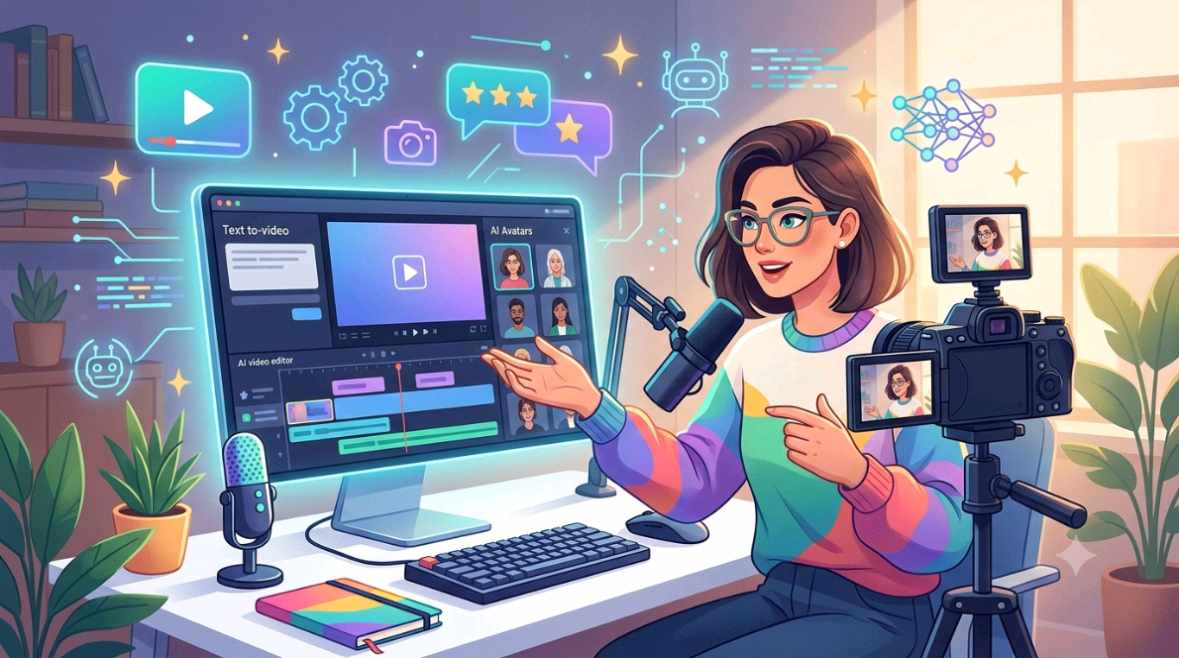
AI can make video creation much easier, even if you do not have professional editing skills. You can use AI video generators, AI editors, text-to-video tools, AI voiceovers, subtitles, avatars and other automation features to create videos for YouTube. However, simply generating hundreds of videos and uploading them is not a reliable monetization strategy. YouTube expects content to follow its monetization policies and provide original value to viewers. AI-generated content can be monetized when the overall content meets the applicable requirements, while repetitive or mass-produced content can create monetization problems.
Best AI Video Tools for Creating YouTube Videos
There are now many AI video creation tools for different purposes. Some turn a written script into a video, some edit existing footage, some create AI presenters, and others generate or modify visual scenes.
The right tool depends on what you want to make. A beginner creating educational videos may need an easy AI video maker, while a professional creator may want advanced AI editing and video generation features.
What Can AI Do for Video Creators?
- Generate a video from a written idea or script.
- Create or improve a video script.
- Generate voiceovers and narration.
- Create subtitles and captions automatically.
- Remove backgrounds and unwanted objects.
- Convert long videos into short clips.
- Create AI presenter or avatar videos.
- Help with thumbnails, titles and video descriptions.
- Improve audio, video quality and speech.
- Turn articles or presentations into video content.
This means AI can work as a video production assistant. The creator still needs to decide the topic, verify information, improve the script, control the final edit and make sure the finished video is useful and original.
AI Apps, Software and Websites for Video Creation
1. InVideo
Best for: Beginners, text-to-video projects, faceless videos and marketing content.
InVideo can help transform a written idea or script into a video project. It is useful when you want AI assistance with scenes, narration, stock visuals and editing.
Simple workflow: Write your topic → prepare the script → generate the video → replace unsuitable scenes → edit the narration and captions → preview → export.
2. CapCut
Best for: YouTube Shorts, social videos and quick mobile editing.
CapCut is popular among creators because it combines traditional editing with AI-assisted features. You can work with captions, effects, background removal, audio tools and other automated editing functions.
It is particularly useful when AI generates the basic material but you want to give the final video a more human editing style.
3. Canva
Best for: Beginners, educational videos, presentations and visual storytelling.
Canva combines video editing with graphic design. It can be useful for creating videos that contain text, illustrations, presentation slides, stock media and branded visuals.
If your YouTube channel focuses on tutorials, education, business or informational content, Canva can be a convenient part of the production workflow.
4. VEED
Best for: Online video editing, captions, social content and browser-based workflows.
VEED provides an online editing environment where creators can work with video, text, subtitles and AI-assisted features. It is useful for creators who do not want to install complicated desktop editing software.
5. Descript
Best for: Podcasts, tutorials, interviews and speech-based videos.
Descript uses a text-based editing approach. After transcription, editing the words can help you edit corresponding parts of the video. This can save time when working with talking-head videos, interviews and educational content.
6. Runway
Best for: Creative AI video generation and advanced visual experiments.
Runway is aimed more toward creators who want AI-assisted visual generation and advanced creative effects. It can be useful for cinematic concepts, visual storytelling and experimental scenes.
7. Pictory
Best for: Turning written content into video.
Pictory is useful for creators who start with articles, scripts or long-form written content. AI-assisted scene selection, captions and narration can reduce the amount of manual work needed to build a video.
8. Synthesia
Best for: Presenter-style videos, training and business communication.
Synthesia focuses on AI presenter videos. Instead of recording yourself, you can create a presentation using an AI avatar and generated narration. This can be useful for tutorials, training and professional explainers.
Which AI Video Tool Should a Beginner Choose?
| Tool | Useful For | Beginner Friendly |
|---|---|---|
| InVideo | Text-to-video and faceless content | Yes |
| CapCut | Shorts and mobile editing | Yes |
| Canva | Visual and educational videos | Yes |
| VEED | Online editing and captions | Yes |
| Descript | Talking videos and podcasts | Yes |
| Runway | Creative AI video generation | Intermediate |
| Pictory | Article-to-video content | Yes |
| Synthesia | AI avatar presentations | Yes |
How to Make an AI Video for YouTube
You do not need to press one button and upload whatever AI creates. A better approach is to use AI as part of a complete AI video production workflow.
Step 1: Choose a Useful Topic
Start with a topic that people actually want to watch. Instead of creating a generic video such as “Amazing AI Facts,” choose a more specific topic such as “How AI Voice Generators Work” or “How to Make Educational Videos with AI.”
Specific topics are often easier to explain clearly and can help you build a focused YouTube channel.
Step 2: Research the Information
AI can help you organize information, but you should not blindly trust every AI-generated statement. Check important facts using reliable sources, especially when your video covers technology, finance, health, law or other sensitive subjects.
Step 3: Create Your Script
Write a script with a strong opening, useful information, examples and a clear conclusion. AI can help generate an outline or improve wording, but your own experience, explanation and perspective can make the video more valuable.
Step 4: Generate or Collect Visuals
Depending on your topic, you can use original recordings, licensed stock footage, screen recordings, graphics, animations or AI-generated visuals. Do not assume that something available online is automatically free to use.
Step 5: Add Voiceover
You can record your own voice or use an AI voice tool where appropriate. A human voice can make informational videos feel more personal, but a high-quality AI voice can also be useful when used responsibly.
Step 6: Edit the Video
This is where you should add your own creative input. Remove unnecessary sections, change weak visuals, improve timing, add captions, highlight important points and make the video comfortable to watch.
Good practice: Don't publish the first version generated by AI. Treat the AI output as a draft and turn it into a finished piece of content through research, editing and original presentation.
Step 7: Create the Thumbnail and Title
Use a clear thumbnail and an honest title. AI can help with ideas, but the final title should accurately represent the video. Avoid misleading thumbnails simply to increase clicks.
How to Upload an AI Video to YouTube
After completing your video, upload it through YouTube Studio just as you would upload other videos.
- Open YouTube Studio.
- Select the upload option.
- Choose your completed video file.
- Add the title and description.
- Upload an appropriate thumbnail.
- Select the relevant audience settings.
- Review the AI or altered-content disclosure when applicable.
- Check copyright and other video details.
- Select visibility such as private, unlisted or public.
- Publish the video after reviewing everything.
Do You Need to Tell YouTube That a Video Was Made With AI?
Sometimes, yes. YouTube requires creators to disclose realistic content that has been meaningfully altered or generated with AI. Examples include making a real person appear to say something they never said, altering footage of a real event or location, or creating a realistic scene that did not actually happen. YouTube provides an AI-use disclosure option during the upload process.
On the other hand, ordinary production assistance such as generating an outline, script ideas, captions, thumbnails or minor visual adjustments generally does not require the same disclosure.
Can AI Videos Be Monetized on YouTube?
Yes, AI-assisted or AI-generated videos can potentially be monetized on YouTube. Using AI does not automatically make a video ineligible for monetization. However, the content still needs to satisfy YouTube's monetization, advertiser-friendly and other applicable policies. YouTube's current guidance emphasizes original and authentic content and identifies repetitive or mass-produced “inauthentic content” as a monetization problem.
What Makes an AI Video More Suitable for Monetization?
- Original research and useful information.
- Your own commentary or explanation.
- Meaningful editing and storytelling.
- Original narration or a properly used AI voice.
- Unique examples and visuals.
- Clear educational, entertainment or informational value.
- Accurate titles and descriptions.
- Properly licensed media and music.
- Compliance with YouTube Community Guidelines.
- Compliance with YouTube monetization policies.
What AI Video Content Can Cause Monetization Problems?
A major risk is creating large numbers of nearly identical videos with little original value. For example, generating a script, using the same AI voice, adding generic stock clips and automatically publishing hundreds of videos can look like mass-produced or repetitive content.
YouTube's monetization guidance says repetitive or mass-produced content can be considered inauthentic and therefore ineligible for monetization.
Important: “AI-generated” and “low-quality automated content” are not the same thing. The technology is not the main issue. The bigger question is whether the finished video provides meaningful, original value to viewers.
Does AI Disclosure Stop Monetization?
No. YouTube states that disclosing qualifying AI-generated or altered content does not by itself limit the video's audience or its eligibility to earn money.
However, disclosure requirements should be followed when applicable. YouTube also says repeated failure to disclose required realistic altered or synthetic content can lead to enforcement actions, potentially including removal from the YouTube Partner Programme.
Best AI Video Strategy for a New YouTube Channel
If you are starting a new channel, do not build your entire strategy around automatic video generation. A better approach is to combine AI speed with human creativity.
- Choose one clear niche.
- Create videos that answer specific viewer questions.
- Use AI for research organization and scripting assistance.
- Add your own examples, experience and explanations.
- Edit every video before publishing.
- Use consistent branding.
- Create useful thumbnails without misleading viewers.
- Improve videos based on audience retention and feedback.
- Focus on quality rather than uploading a large number of videos.
Example of a Strong AI Video Workflow
Topic research → Script → Fact checking → AI visuals/stock footage → Voiceover → Manual editing → Captions → Thumbnail → AI disclosure if required → YouTube upload → Performance analysis.
This workflow is much stronger than simply asking an AI tool to “make a video” and uploading the result without checking it.
AI Video Ideas for YouTube
AI can be used in many different YouTube niches. Some useful ideas include:
- Technology explainers
- AI tutorials
- Software tutorials
- Educational videos
- History storytelling
- Science explainers
- Travel information
- Business education
- Product tutorials
- Animation and storytelling
- Documentary-style educational content
- How-to videos
The strongest channel idea is usually not “AI videos.” Instead, think about what problem you can solve for viewers using AI-assisted video production.
Common Mistakes When Making AI YouTube Videos
1. Publishing Without Checking Facts
AI can produce incorrect or outdated information. Always verify important claims before publishing.
2. Using Copyrighted Material Without Permission
Do not assume that downloading images, music, movie clips or other videos from the internet gives you permission to use them commercially.
3. Making Every Video Look the Same
Identical scripts, voices, visuals and structures can make a channel feel repetitive. Add variety and genuine creative input.
4. Creating Fake Real-World Events
Realistic AI scenes involving real people, places or events require special care. If qualifying realistic altered or synthetic content is used, follow YouTube's disclosure requirements.
5. Uploading Too Many Low-Quality Videos
More uploads do not automatically mean more success. A smaller number of useful, well-produced videos can be a better long-term strategy.
6. Depending Completely on AI
AI should reduce repetitive work, not remove the creator from the creative process. Your research, judgment, storytelling and editing can make the difference between generic content and valuable content.
AI Video Creation: Human Creativity Still Matters
The biggest advantage of AI video tools is speed. A creator who previously needed several hours to prepare a basic video may now be able to complete parts of the process much faster.
But speed should not become the only goal. YouTube viewers still want videos that are interesting, useful, trustworthy and easy to understand. AI can help create the raw material, but the creator is responsible for deciding what should finally reach the audience.
For this reason, the best approach is AI-assisted content creation rather than completely automated content production.
Frequently Asked Questions About AI Videos
Can I make YouTube videos completely with AI?
Yes, it is technically possible to create many parts of a video with AI, including scripts, visuals, narration and editing. However, adding human research, creativity, editing and original value is a much better approach for building a sustainable channel.
Can AI-generated videos be monetized?
Yes, AI-generated or AI-assisted videos can potentially earn money if they meet YouTube's applicable monetization and content policies. AI use alone does not automatically prevent monetization. However, repetitive or mass-produced content may be ineligible.
Does YouTube ban AI videos?
No. YouTube allows creators to use AI, but certain realistic AI-generated or meaningfully altered content must be disclosed, and all content must follow YouTube's policies.
Do I have to disclose an AI-generated video?
If the video contains realistic AI-generated or meaningfully altered content covered by YouTube's disclosure requirements, you should disclose it during the upload process. Minor editing assistance and some non-realistic uses do not require the same disclosure.
Which AI video tool is best for beginners?
There is no single best tool for everyone. InVideo, CapCut, Canva and VEED can be useful starting points for beginners, while Runway, Descript, Pictory and Synthesia are better suited to particular workflows.
Can I make faceless YouTube videos with AI?
Yes. You can combine scripts, AI voiceovers, stock footage, screen recordings, animations, graphics and AI-generated visuals to make faceless videos. The important point is to create meaningful and original content rather than mass-producing generic videos.
Can AI create YouTube Shorts?
Yes. AI can help generate scripts, visuals, captions, voiceovers and edits for Shorts. Tools such as mobile AI editors can make the process faster, but the final Short should still be useful and engaging.
Will an AI label automatically reduce my YouTube earnings?
YouTube states that disclosing qualifying AI-generated or altered content does not by itself affect audience reach or monetization eligibility. Monetization decisions still depend on the applicable policies and the overall quality and nature of the content.
Conclusion
AI has made video creation easier, faster and more accessible. You can use AI video generators, editors, voice tools, avatars and text-to-video platforms to create content for YouTube without becoming a professional video editor.
However, the smartest strategy is not to upload unlimited automatically generated videos. Instead, use AI as a production assistant and add your own research, creativity, commentary, editing and storytelling.
AI videos can be monetized, but monetization is not guaranteed simply because a video was created with an AI tool. Your channel and videos must satisfy YouTube's applicable monetization policies, and repetitive or mass-produced content can create problems.
If your goal is long-term YouTube growth, focus on one niche, create genuinely useful videos, verify your information, use properly licensed media, disclose qualifying realistic AI content and make every video better than the previous one.
Disclaimer
This article is provided for general informational and educational purposes. AI tools, features, pricing, copyright rules and platform policies can change over time. YouTube monetization is not guaranteed for any individual video or channel. Always review the latest official YouTube policies and the terms of the AI tools you use before publishing or monetizing content.